
Two years ago, electric cars in Pakistan were a curiosity for the very rich. In 2026, it is a real showroom choice: BYD, Deepal, Hyundai, Kia, and Audi all sell EVs here, prices start under Rs 75 lakh for a family crossover, and the government’s new tax breaks have changed the maths. This guide to electric cars in Pakistan covers 2026 prices, the tax and loan incentives, charging reality, running costs, and the risks you should know before booking.
Electric Cars in Pakistan: 2026 Prices
Prices are ex-factory or ex-showroom unless noted, and they move with taxes, duties, and exchange rates — confirm with a dealer before booking. Registration and freight can add a meaningful amount on top.
Model | Approx. price | Battery | Claimed range |
|---|---|---|---|
Alektra Metro (micro car) | Rs 10.95 lakh | Small city pack | City use |
BYD Atto 2 | Rs 72.9 lakh | 45.12 kWh | 380 km (NEDC) |
GWM ORA 5 | Rs 85.99 lakh | 58.33 kWh | ~400 km |
BYD Atto 3 Advance | Rs 89.9 lakh | 49.92 kWh Blade | 410 km (NEDC) |
Deepal L07 | Rs 1.40 crore | 66.8 kWh | ~500 km |
Deepal S07 | Rs 1.50 crore | 66.8 kWh | 485 km (NEDC) |
BYD Sealion 7 | Rs 1.55 crore | 82.56 kWh | 567 km |
BYD Seal | Rs 1.48–1.70 crore | 61.44 kWh | 650 km |
Kia EV5 | Rs 1.85–2.35 crore | 64.2–88.1 kWh | Up to 620 km |
Hyundai IONIQ 5 | From Rs 2.25 crore | — | — |
Audi e-tron | Up to ~Rs 2.16 crore | — | — |
Electric cars in Pakistan now split cleanly into bands. Micro cars under Rs 15 lakh are city-only runabouts. The family sweet spot is Rs 72–90 lakh, led by the BYD Atto 2 and Atto 3. Above Rs 1.4 crore you get long-range sedans and SUVs — the Deepal pair, the BYD Seal and Sealion 7 — and beyond Rs 2 crore you are in luxury territory with Hyundai, Kia, and Audi. For context, a petrol Honda Civic or Toyota Corolla Cross sits in the same Rs 90 lakh–1.2 crore band as the family EVs, so the purchase-price gap that once killed EVs has narrowed sharply.
Which Electric Cars in Pakistan Fit You?
City-only second car: a micro car like the Alektra Metro makes sense if your daily driving is short, urban, and you have home charging. It is not a highway car.
Family buyers: the BYD Atto 3 Advance is the default recommendation among electric cars in Pakistan in this price band — a 49.92 kWh Blade battery, 150 kW motor, 410 km claimed range, CCS2 charging, and real cabin space for a family. The Atto 2 saves about Rs 17 lakh if your range needs are smaller.
Long-distance drivers: the Deepal S07 or BYD Sealion 7, with 66–82 kWh packs and 485–567 km claimed range, give you the buffer that makes motorway driving comfortable. Remember the rule from our electric cars battery life guide: real range is typically 75–85% of claimed, so plan trips on 400 km of real range for a 500 km claim.
Luxury buyers: the Kia EV5, Hyundai IONIQ 5/6, and Audi e-tron compete on badge, interior, and dealer experience rather than value — and their service networks are the most established of the lot.
Tax Breaks and Loans: The Policy Tailwind
Electric cars in Pakistan benefit from a policy stack that petrol cars do not get. Under the New Energy Vehicle Policy 2025–2030 and the draft Auto Policy 2026–31 approved by the Prime Minister, battery electric vehicles get the most preferential treatment, followed by range-extender EVs and plug-in hybrids:
- 1% sales tax on NEVs, their CKD kits, parts, and raw materials — against 25% sales tax on many conventional cars.
- Exemptions from Federal Excise Duty, Capital Value Tax, and withholding tax for NEVs.
- Bigger loans: the NEV financing limit rises from Rs 30 lakh to Rs 1 crore, with the repayment period extended from three years to five.
- Cheaper charging infrastructure: 1% customs duty on imported charging stations.
- Local assembly coming: BYD is building a $150 million assembly plant near Karachi, with its first locally built vehicles expected later in 2026 — local assembly usually means better parts availability and, over time, lower prices.
One important distinction: the famous Rs 80,000 PAVE subsidy applies to electric bikes, not cars — cars get their help through tax breaks and loans instead. And because the 2026–31 auto policy is still moving through legal vetting and IMF review, treat the newest incentives as approved-in-draft rather than settled law, and confirm the current tax treatment at booking time.
Charging Reality: Home First, Highways Second
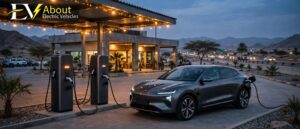
Be honest about electric cars in Pakistan before you buy: the public charging network is still thin. Roughly 19 DC fast-charging stations cover the Karachi–Peshawar corridor (HUBCO Green), and coverage outside major cities and motorways is patchy. That is why the buying decision starts with one question: can you charge at home?
Home charging is the norm for most owners. A standard home socket or a wallbox (7–11 kW) fills a 50 kWh car overnight — about 6–8 hours on a wallbox, longer on a plain socket. If you live in an apartment without a dedicated parking socket, an EV is much harder to own today; check that first, not last.
Public charging costs are regulated in your favour: the government cut the EV charging tariff from Rs 71.10 to Rs 39.70 per unit in January 2025, and public chargers pay a NEPRA base rate of Rs 23.57 per unit plus their own margin. So a public top-up is pricier than home charging but still far cheaper than petrol.
For motorway trips, plan around the corridor chargers, keep a 20% buffer, and remember that heat, speed, and air conditioning all cut range. Our guide to electric car charging time explains the charging curve — the last 20% is slow, so road-trip charging means 20–80% stops, not full charges.
Running Costs: Where the Savings Live
Work through a family example for electric cars in Pakistan: 1,500 km a month in a BYD Atto 3, using about 15 kWh per 100 km.
Electric: 225 kWh a month. At a household tariff of roughly Rs 35 per unit, that is about Rs 7,900 a month — roughly Rs 5 per kilometre.
Petrol: a comparable petrol crossover doing 12 km per litre needs 125 litres. At around Rs 380 per litre, that is roughly Rs 47,500 a month — roughly Rs 32 per kilometre.
The saving is roughly Rs 40,000 a month for a heavy user, or nearly Rs 4.8 lakh a year — enough to close the purchase-price gap within a couple of years, before counting lower maintenance (no oil changes, no gearbox, far less brake wear). Light users save less, but the direction is the same. Two caveats: electricity tariffs and petrol prices both move — Pakistan moved to daily petrol pricing in 2026 — and public fast charging costs more than home charging, so the saving is biggest for home chargers.
Problems to Know Before Buying
First, resale values for electric cars in Pakistan are unproven. The used EV market in Pakistan is tiny, so a three-year-old EV’s value is a guess, unlike a Corolla’s. Second, service depth varies: BYD and Deepal are expanding fast, but a workshop in your city matters more than a showroom.
Third, battery replacement is the big long-term bill — packs are warranted for years, but an out-of-warranty replacement can cost a large fraction of the car’s value; our electric car battery replacement cost guide explains the maths. Fourth, price volatility: duties and exchange rates move, so today’s ex-factory price may not be next month’s. Finally, charging outside the corridor needs planning — an EV is a superb city and corridor car today, and a compromise for remote routes.
FAQs
Q.1 What is the cheapest electric car in Pakistan in 2026?
Micro cars like the Alektra Metro start around Rs 10.95 lakh, while the cheapest family-size EV is the BYD Atto 2 at about Rs 72.9 lakh. Both figures are ex-factory and exclude registration and freight.
Q.2 Is there a government subsidy for electric cars in Pakistan?
Not a cash subsidy like the Rs 80,000 PAVE grant for electric bikes. Electric cars in Pakistan benefit instead through tax breaks: 1% sales tax on NEVs, exemptions from Federal Excise Duty, Capital Value Tax, and withholding tax, plus a higher loan limit of Rs 1 crore over five years.
Q.3 Can I charge an electric car at home in Pakistan?
Yes — most owners do. A wallbox (7–11 kW) charges a 50 kWh car overnight in about 6–8 hours; a plain socket works but is slower. Apartment dwellers should confirm a dedicated parking socket before buying.
Q.4 How far do electric cars in Pakistan really go?
Plan on 75–85% of the claimed range. A car claiming 410 km (BYD Atto 3) realistically delivers about 310–350 km; a 567 km claim (Sealion 7) means roughly 425–480 km in real driving.
Q.5 Are electric cars in Pakistan cheaper to run than petrol cars?
Yes, substantially — roughly Rs 5 per kilometre on home charging against roughly Rs 32 per kilometre for a petrol crossover at current prices. The gap narrows if you rely on public fast charging, but it stays large.
Q.6 Should I wait for local assembly?
If you are buying a BYD, it is worth asking the dealer about locally assembled timelines — local assembly usually improves parts availability and can soften prices. But if you need a car now, the current tax breaks already make the case; waiting has its own cost in fuel bills.
Conclusion
Electric cars in Pakistan have reached the point where the question is no longer “is it possible?” but “does it fit my life?” If you have home charging, drive mostly in cities and on the Karachi–Peshawar corridor, and buy in the Rs 72–90 lakh family band, the maths is already compelling: lower running costs, strong tax breaks, and a rapidly improving choice of cars. If you lack home charging or regularly drive remote routes, wait for the network — or look at a plug-in hybrid as a bridge. For electric cars in Pakistan, the checklist is simple: confirm the price, the tax treatment, and the service network in your city before you book.