
Electric car range tells you how far an electric vehicle can travel on a full battery charge. It is one of the most important things to check before buying an EV. A car may have a high advertised range, but your real driving range can change because of speed, weather, road conditions, battery size, driving style, and climate control use.
Understanding electric car range helps you choose the right EV and plan your daily and long-distance trips more easily.
What Is Electric Car Range?
Electric car range is the distance an EV can travel before its battery needs to be charged again. Manufacturers usually provide an estimated range based on standardized testing.
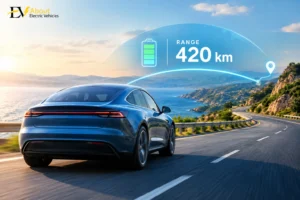
For example, an EV rated at 400 km may not always travel exactly 400 km in real-world driving. Driving at high speeds, extreme temperatures, carrying heavy loads, driving uphill, or accelerating quickly can use more battery power and reduce your EV’s range. City driving can sometimes be more efficient because frequent stops allow regenerative braking to recover some energy.
How Is Electric Car Range Calculated?
Electric car range mainly depends on battery capacity and energy efficiency.
A simple way to estimate range is:
Range = Battery Capacity ÷ Energy Consumption × 100
For example, if an EV has a 60 kWh battery and uses 15 kWh per 100 km:
60 ÷ 15 × 100 = 400 km
If the same car uses 20 kWh per 100 km:
60 ÷ 20 × 100 = 300 km
This shows why two electric cars with similar battery sizes can have different driving ranges.
What Affects Electric Car Range?
Several factors can change your electric car range during everyday driving.
Battery Size
A larger battery can store more energy and usually provides more range. However, a bigger battery also adds weight, which can affect efficiency. Battery size is measured in kilowatt-hours (kWh). For example, a 70 kWh battery can store more energy than a 50 kWh battery.
Driving Speed
Speed has a major effect on EV efficiency. Driving faster, especially on highways, requires more energy because the vehicle has to overcome greater air resistance. This means an EV may travel fewer kilometers at high highway speeds than it would during slower city driving.
Weather
Extreme temperatures can reduce electric car range. In cold weather, an EV uses extra battery power to warm the battery and heat the cabin, which can reduce the car’s driving range. In hot weather, the air-conditioning system also uses energy. Preconditioning the car while it is still plugged in can help in cold conditions by warming the cabin and battery before driving.
Driving Style
Hard acceleration, sudden braking, and aggressive driving can use more energy. Smooth acceleration and steady driving can help you get better efficiency and more consistent electric car range.
Road and Vehicle Load
Hills, strong wind, rough roads, passengers, and heavy luggage can increase energy consumption. A fully loaded vehicle generally needs more energy to move than a lightly loaded one.
Electric Car Range in City Driving
City driving can sometimes give an EV good efficiency because regenerative braking can recover some energy when the vehicle slows down. However, heavy traffic, frequent acceleration, extreme temperatures, and frequent use of air conditioning can still reduce range.
or everyday city driving, you usually do not need an EV with the longest possible range. A vehicle with enough range for your normal daily distance can be more practical and affordable.
Electric Car Range on Highways
Highway driving usually uses more energy than slower city driving because of higher speeds and aerodynamic drag. This means an EV with a 400 km official range may provide less range during a long highway trip, especially when driven at high speed.
If you regularly travel long distances, consider an EV with a larger battery, good highway efficiency, and fast charging capability.
Does Air Conditioning Reduce Electric Car Range?
Yes. Heating and cooling use electricity from the vehicle’s battery. The effect depends on the weather, vehicle, temperature setting, and how long the climate system operates. Very hot or cold weather can reduce an EV’s range because the heating or air conditioning uses extra battery power. Preconditioning the car while it is still plugged in can help, as the battery can use less energy for climate control once you start driving.
Does a Bigger Battery Always Mean More Range?
Not always.
A larger battery can store more energy and may provide more range, but the storage capacity just not depends on the size of battery. Range also depends on the vehicle’s mass, efficiency, shape, tires, motor, and driving conditions. A heavier vehicle may use more energy even with a large battery, while a lighter, more efficient EV can achieve similar or better range with a smaller battery.
How Much Electric Car Range Do You Need?
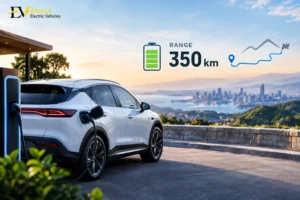
The right electric car range depends on how you drive. If you mainly drive to work, school, shopping areas, or other nearby places, you may not need an EV with an extremely long range. For example, if your daily driving is around 50 km, a car with a practical range of 250–300 km may already provide plenty of flexibility.
If you often travel long distances between cities, an EV with a longer range can help you travel farther without stopping to charge as often. Think about your normal daily distance first, then consider your occasional long trips.
Electric Car Range vs Charging Speed
Range and charging speed are different.
A long-range EV can travel farther before it needs to recharge, while a fast-charging EV can add energy more quickly during a charging stop. DC fast charging is useful on long trips because it can charge battery fast. However, the actual charging speed depends on the charger quality, as well as factors such as battery temperature and state of charge. For long-distance driving, both range and charging speed are important.
How to Improve Electric Car RangeYou can often improveyour real-world rangeby changing a few driving habits:
- Drive at a steady and reasonable speed.
- Avoid unnecessary hard acceleration.
- Keep tires properly inflated.
- Remove unnecessary heavy items from the vehicle.
- Use climate control efficiently.
- Precondition the vehiclewhile plugged in when appropriate.
- Use regenerative braking when available.
- Plan charging stops before long trips.
- Choose routes that reduce unnecessary hills or delays when practical.
- These simple habits can help reduce energy consumption and make your electric car range more predictable.
- Electric Car Range and Battery Degradation
Battery capacity can decrease gradually as an EV gets older. This process is called battery degradation. When battery health decreases, the vehicle may have less usable energy than it had when new. As a result, its electric car range can also decrease.
A 2026 Geotab analysis of more than 22,700 EVs found an average battery degradation rate of about 2.3% per year. The study also found that vehicles mainly using high-power DC fast charging above 100 kW could experience higher degradation rates, although battery performance varies by vehicle and usage.
This does not mean fast charging should never be used. It is useful when you need it, especially during long trips. For regular charging, slower charging can be a practical option when available.
Should You Trust the Advertised Electric Car Range?
Use the advertised range as a useful starting point, not a guaranteed distance. Official range tests provide a standard way to compare vehicles, but your actual results can be different.
Your real electric car range depends on:
- Speed
- Weather
- Traffic
- Road conditions
- Driving style
- Passenger and cargo weight
- Heating and air conditioning
- Battery condition
- Tire pressure
If you are comparing EVs, look at official range figures but also consider real-world driving conditions and your own daily needs.
How to Get the Most From Your Electric Car Range
The best way to maximize range is to focus on efficiency rather than simply buying the biggest battery. Keep your tires properly inflated, avoid unnecessary weight, drive smoothly, and reduce excessive high-speed driving when practical.
During extreme weather, use preconditioning while the car is connected to a charger. This can help preserve battery energy for driving. For long trips, keep enough battery reserve for unexpected traffic, weather changes, or a charging station that is unavailable.
FAQs About Electric Car Range
Q.1 What is a good electric car range?
A good range depends on your driving needs. For daily commuting, moderate range may be enough. For frequent highway travel, a longer-range EV can provide more convenience.
Q.2 How far can an electric car go on one charge?
It depends on the vehicle, battery, efficiency, and driving conditions. Always check the manufacturer’s official range and consider that real-world range can be lower.
Q.3 Does highway driving reduce electric car range?
Yes. Higher speeds increase aerodynamic drag and usually require more energy, so highway driving can reduce range compared with efficient city driving.
Q.4 Does cold weather reduce EV range?
Yes. Cold temperatures can reduce range because the battery and cabin require additional energy. Preconditioning while plugged in can help.
Q.5 Does air conditioning reduce electric car range?
Yes. Air conditioning uses electricity from the battery, so heavy use can reduce the distance you can travel.
Q.6 Does battery size affect electric car range?
Yes. A larger battery can store more energy, but the final range also depends on vehicle efficiency, weight, speed, and driving conditions.
Conclusion
Electric car range is an important factor when choosing an EV, but the advertised number is not the whole story. Battery size, vehicle efficiency, speed, weather, road conditions, driving style, and climate control can all affect how far you can actually travel. For daily driving, choose a range that comfortably covers your normal trips. If you often travel long distances, look for a combination of good range and fast charging.
The best EV is not necessarily the one with the biggest battery. It is the one that gives you enough range, efficient performance, convenient charging, and a driving experience that fits your needs.Electric Car Range: Complete Guide to EV Range and Real-World Driving
Electric car range tells you how far an electric vehicle can travel on a full battery charge. It is one of the most important things to check before buying an EV. A car may have a high advertised range, but your real driving range can change because of speed, weather, road conditions, battery size, driving style, and climate control use.
Understanding electric car range helps you choose the right EV and plan your daily and long-distance trips more easily.