
Electric car charging is one of the first things you need to understand when switching from a gasoline car to an electric vehicle. Instead of visiting a fuel station, you connect the vehicle to a power source and add electricity to its battery. The basic idea is simple, but charging can become confusing when you start hearing terms such as Level 1, Level 2, DC fast charging, charging speed, battery capacity, connectors, and charging networks.
The good news is that you do not need to understand every technical detail to charge an EV properly. You mainly need to know which charging option fits your daily driving, how long charging may take, where you can charge, and what affects charging speed.
What Is Electric Car Charging?
Electric car charging is the process of supplying electrical energy to an EV’s battery. An all-electric vehicle uses a large traction battery to power its electric motor. When the battery needs energy, the car connects to charging equipment through its charge port.
You can charge an EV at home, at work, or at a public charging station. The charging equipment sends electricity to the vehicle, while the car’s charging system controls how that electricity is accepted by the battery. Charging does not always happen at the same speed. The vehicle, charger, battery condition, and available electrical power all affect how quickly energy can be added.
How Does Electric Car Charging Work?
When you plug an EV into a charging source, electricity moves from the power supply toward the vehicle’s battery. For normal AC charging, such as Level 1 or Level 2, the electricity is supplied as alternating current. The vehicle’s onboard charger converts it into the form needed to store energy in the battery.
DC fast charging works differently. It supplies direct current to the vehicle’s battery system, allowing higher charging power without relying on the same AC-to-DC conversion process inside the vehicle. The actual charging speed is controlled by several limits. A powerful charging station cannot automatically make every EV charge at that station’s maximum power. The vehicle itself must be capable of accepting that amount of power.
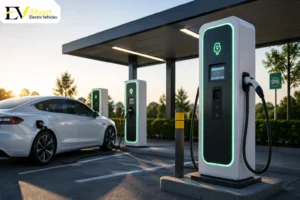
Types of Electric Car Charging
There are three main charging categories you should know about:
- Level 1 charging
- Level 2 charging
- DC fast charging
They are designed for different situations rather than being direct replacements for one another.
Level 1 Electric Car Charging
Level 1 is the simplest form of EV charging. It normally uses a standard household outlet and provides electricity at a relatively low power level. Because the charging speed is slow, Level 1 can work well for drivers who have low daily mileage and leave their vehicle parked for long periods.
For example, if you only drive a short distance each day, leaving the car connected overnight may provide enough energy for your next trip. The U.S. Department of Energy’s Alternative Fuels Data Center lists Level 1 charging at approximately 5 miles of range per hour under its stated assumptions, although actual results vary by vehicle and conditions.
Level 2 Electric Car Charging
Level 2 charging provides significantly more power than Level 1 and is commonly used at homes, workplaces, and public charging locations. A residential Level 2 charger generally uses a 240-volt electrical supply. Because it can add energy much faster than Level 1, it is a practical choice for drivers who regularly use their EV and want to recharge while the car is parked at home.
The DOE notes that Level 2 equipment can provide around 25 miles of range per hour under typical assumptions, but the actual result depends on the vehicle and charger. Level 2 is often a good middle ground because it provides much faster charging without requiring the high power used by DC fast chargers.
DC Fast Charging
DC fast charging is designed for situations where you need a large amount of energy in a relatively short time. These chargers are commonly found at public locations and along major travel routes. Depending on the vehicle and charging station, DC fast charging can add a substantial amount of range during a short stop.
However, charging speed is not constant throughout the entire session. The vehicle may reduce charging power as the battery becomes highly charged.
How Long Does Electric Car Charging Take?
There is no single charging time that applies to every EV.
Charging time depends on:
- Battery size
- Current battery level
- Charger power
- Vehicle charging limit
- Battery temperature
- Charging conditions
A small battery connected to a suitable charger may charge relatively quickly, while a larger battery can take longer. The starting battery level also matters. Charging from 20% to 80% is different from trying to fill a nearly empty battery completely. This is why manufacturers often provide estimated charging times for specific charging conditions rather than one universal number.
What Is the Best Electric Car Charging Method at Home?
For home use, the best option depends on how much you drive. If you drive only a short distance each day and your car remains parked overnight, Level 1 may be enough. If you drive more frequently or want faster overnight charging, Level 2 may be more suitable.
Before installing a home charger, check your home’s electrical capacity and the installation requirements for the charger you want to use. A qualified electrician can determine whether additional electrical work is needed. The goal is not to install the most powerful charger available. The goal is to install a charging setup that matches your vehicle and your normal driving requirements.
Home Charging vs Public Charging
Home and public charging serve different purposes. Home charging is convenient because you can charge while the vehicle is parked. You do not need to make a separate trip to a charging station for most everyday driving.
Public charging becomes more useful when you are away from home, live somewhere without suitable parking, or travel long distances. The DOE states that most EV charging occurs at home, while public charging helps extend usable range and supports drivers who need charging away from their normal location.
For many drivers, the most practical setup is to use home charging for regular driving and public charging when necessary.
How Much Does Electric Car Charging Cost?
The cost of charging depends mainly on how much electricity your EV uses and what you pay for that electricity.
A simple calculation is:
Charging cost = electricity used × electricity price
For example, if your vehicle uses 30 kWh and your electricity rate is $0.15 per kWh:
30 × $0.15 = $4.50
That means the basic electricity cost would be $4.50.
Public charging can work differently because charging networks may use their own pricing structures and may include additional fees. Your vehicle’s efficiency also matters. An efficient EV may travel farther using the same amount of electricity.
What Affects Charging Speed?
Charging speed is not determined by the charger alone. The vehicle’s maximum charging capability is one of the most important factors. If a car can only accept a certain amount of power, connecting it to a much more powerful station will not automatically make it charge at the station’s full output.
Battery temperature can also affect charging. A battery that is too cold or too hot may charge differently from one operating within its preferred temperature range. The battery’s current state of charge matters as well. Charging power often changes during a session, especially as the battery approaches a high state of charge.
The AFDC notes that charging time varies with factors including battery state of charge, battery capacity, battery type, vehicle onboard charging capability, and charging equipment.
Why Does EV Charging Slow Down?
You may notice that your EV charges quickly at one point and more slowly later.
This is normal. The charging system manages power to protect the battery and maintain safe operating conditions. As the battery gets closer to a high state of charge, the vehicle may reduce the amount of power it accepts.
For this reason, the time required to add the final portion of the battery can be longer than the time needed to add the same percentage earlier in the session. When traveling, many EV drivers therefore stop for a useful amount of range rather than waiting for the battery to reach 100%.
Does Weather Affect Electric Car Charging?
Temperature can influence EV charging performance. Very cold or very hot conditions can affect battery operation and may change how quickly the battery accepts energy. Cold temperatures can be especially important because the battery may need to reach a suitable operating temperature before accepting high charging power.
If your vehicle supports battery preconditioning, it may prepare the battery for charging before you reach a fast-charging station. Weather also affects the amount of energy the vehicle needs while driving. Heating, air conditioning, and other systems can increase energy use, which can change how often you need to charge.
How to Find a Public Charging Station
Finding a public charger is becoming easier, but you should still plan ahead for longer trips.
- You can use:
- EV navigation systems
- Charging network apps
- Public charging maps
- Vehicle manufacturer apps
- Charging station directories
Before relying on a station, check whether its connector is compatible with your vehicle and whether the station provides the charging speed you need. A charging location can have multiple ports, and different connectors may be available. A charging port is the point where one vehicle receives electricity, while the connector is the plug that connects the station to the vehicle.
Electric Car Charging Connectors
Charging connectors can vary between vehicles and markets. The important thing is to know which connector your EV uses for AC charging and which one it uses for DC fast charging.
Common connector standards include J1772, CCS, CHAdeMO, and J3400/NACS in the United States. Availability depends on the vehicle and market. Before using a public charger, make sure the connector matches your vehicle or that you have an approved adapter when appropriate.
How to Make EV Charging Easier
You do not need to make charging complicated. Start by understanding your daily driving distance. If you normally drive a short distance and park at home overnight, slow charging may be completely adequate.
If you drive more, a Level 2 home charger can provide a faster way to replace the energy you use each day. For road trips, identify suitable fast-charging locations before you leave. Also consider your vehicle’s charging capability rather than choosing a station based only on its advertised power. The simplest charging setup is usually the one that fits your normal routine.
Electric Car Charging for Long Trips
Long-distance EV travel requires a little more planning than normal daily charging. Before starting a long trip, check your expected range, charging locations, and the approximate distance between stops.
Do not plan a route that depends on reaching a charger with almost no battery remaining. Traffic, weather, speed, hills, and other conditions can increase energy use. It is better to keep a reasonable buffer and have another charging option available when practical. Fast chargers are particularly useful on long journeys because they can reduce the time spent waiting for energy.
Common Electric Car Charging Mistakes
New EV owners sometimes make charging more complicated than it needs to be. One common mistake is assuming that every charger will provide the same charging speed. The vehicle’s own charging capability matters just as much as the station. Another mistake is ignoring connector compatibility.
It is also easy to assume that you must charge the battery to 100% every time. Your daily charging routine should follow the vehicle manufacturer’s recommendations and your actual driving needs. Finally, do not choose a home charger simply because it has the highest power rating. A charger should match your vehicle, electrical system, and daily requirements.
FAQs About Electric Car Charging
Q.1 How does electric car charging work?
Electric car charging supplies electrical energy to an EV’s battery through a charging connection. The vehicle manages the charging process based on its battery and charging system.
Q.2 What is the difference between Level 1 and Level 2 charging?
Level 1 uses a standard household electrical outlet and charges slowly. Level 2 uses higher-power AC charging and can replenish an EV much faster.
Q.3 Is Level 2 charging better than Level 1?
Not always. Level 2 is better for drivers who need faster charging, while Level 1 can be enough for people with low daily mileage and long parking periods.
Q.4 What is DC fast charging?
DC fast charging is a high-power charging method designed to add substantial battery energy quickly. It is commonly used for public charging and long-distance travel.
Q.5 Can I charge an electric car at home?
Yes. EVs can be charged at home using suitable charging equipment. The right setup depends on your vehicle, daily driving, available electrical service, and charging needs.
Q.6 How long does it take to charge an EV?
Charging time varies by battery size, starting charge level, charger power, vehicle charging capability, and temperature. There is no single charging time for every EV.
Q.7 Is electric car charging expensive?
The cost depends on your electricity rate, vehicle efficiency, amount of energy used, and whether you use home or public charging. Home charging can often be a convenient option for regular driving.
Q.8 Can I use a public charger with any EV?
Not necessarily. The charger must have a compatible connector or an appropriate approved adapter, and the vehicle must support the charging type being offered.
Q9. Should I charge my EV to 100% every day?
Not necessarily. Your ideal charging routine depends on the vehicle and your daily driving requirements. Follow the manufacturer’s battery-care recommendations rather than assuming that every EV should use the same charging routine.
Conclusion
Electric car charging is much simpler once you understand the basic options. Level 1 is useful for slower home charging, Level 2 provides faster everyday charging, and DC fast charging is mainly valuable when you need to add range quickly.
The best charging setup depends on how far you drive, where you park, how much time your car normally spends parked, and what charging equipment your EV supports. For many drivers, a simple home charging routine can handle most daily needs, while public fast chargers provide flexibility for longer trips.
Instead of choosing the fastest charger available, focus on the charging setup that fits your actual routine. Understanding your EV’s charging capability, connector, battery, and typical energy needs will make owning and charging an electric car much easier.