
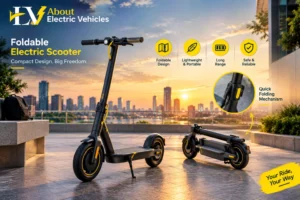
A foldable electric scooter gives you powered transportation without taking up as much space as a traditional full-size scooter. Its main advantage is simple: you can fold the frame or steering column and make the scooter easier to store, transport, or carry. This makes it useful for commuting, short city trips, apartments, offices, and mixed travel.
But folding alone does not make a scooter portable. Weight, folded dimensions, latch quality, battery size, wheels, and overall design all affect how easy it is to live with. A good buying decision starts with your daily routine, not just the product’s advertised range or speed.
What Is a Foldable Electric Scooter?
A foldable electric scooter is a battery-powered stand-up scooter designed with a folding mechanism. Depending on the model, the handlebar stem, steering column, or another part of the frame folds toward the deck. The purpose is mainly storage and transportation. You may be able to place the scooter in a car trunk, keep it under a desk, store it in a closet, or carry it into a building.
However, foldable models vary greatly. Some are light enough for regular carrying, while larger long-range scooters can still be difficult to lift even after folding. The word “foldable” should therefore be treated as a feature, not proof of portability.
Folded Size and Weight Matter Most
If portability is your main reason for buying, check these specifications before anything else. First, look at the scooter’s actual weight. A model that weighs around 25 pounds may be manageable for frequent carrying, while a much heavier scooter can become tiring on stairs. Current 2026 buying guides also emphasize carry weight and folded dimensions when judging genuine portability.
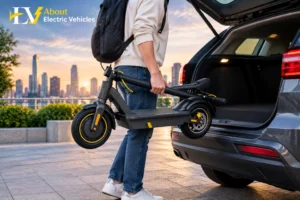
Next, check the folded length, height, and width. Measure the place where you plan to store it. If you will use a car, measure the trunk opening rather than only the trunk volume. Also consider the carrying point. A scooter may have a reasonable total weight but still feel awkward if there is no comfortable way to hold it.
Folding Mechanism and Lock
A folding system should feel secure when riding and predictable when closing. Look for a clear locking mechanism that prevents unwanted movement while the scooter is being used. Before every ride, make sure the folding joint is fully locked according to the manufacturer’s instructions. Do not ride if the latch is loose, damaged, or not engaging correctly. If you fold the scooter every day, convenience becomes important. A mechanism that takes only a few seconds and works consistently can make the scooter much easier to use.
Battery and Range
Battery capacity affects how far the scooter can travel between charges. It is often listed in watt-hours, or Wh. More capacity generally means more stored energy, but it can also add weight. Do not rely completely on the maximum range printed by a manufacturer. Actual distance can change with rider weight, speed, hills, wind, tire pressure, temperature, road surface, and acceleration.
Think about your normal trip instead. If your daily round trip is 10 miles, you should not choose a scooter whose realistic range is only slightly above 10 miles. A reserve gives you more flexibility when conditions are less favorable.
Motor Power and Speed
Motor power affects acceleration and hill performance. A lighter scooter with a modest motor can work well on flat streets, while heavier riders or hilly routes may require more capable hardware. Do not choose solely by the biggest watt number. Look at the scooter’s intended rider weight, hill capability, acceleration behavior, and real-world reviews when available.
Top speed should also match your environment. More speed is not always an advantage, especially on crowded streets or uneven paths. Local laws may set limits on speed and where electric scooters can be used, so check the rules that apply to you.
Tires, Suspension, and Comfort
Tire design has a major effect on ride quality. Pneumatic tires can provide useful cushioning over small bumps but require pressure checks and can suffer punctures. Solid tires reduce puncture concerns but may feel harsher on rough surfaces.
Suspension can improve comfort when your route includes broken pavement, cracks, or uneven roads. It also adds weight and complexity. If you mainly ride on smooth pavement, a lightweight scooter without advanced suspension may be easier to carry. If your roads are rough, comfort may be worth the additional weight.
Brakes and Safety Features
A portable scooter still needs dependable stopping power. Depending on the design, braking may involve electronic braking, a drum brake, disc brakes, or a combination. Check that the brakes respond smoothly and that the controls feel predictable. Also look for useful visibility features such as a headlight, rear light, and reflectors where appropriate.
CPSC advises riders to follow local traffic laws, keep both hands on the handlebars, ride with only one person, and slow down around bumps. It also recommends using micro mobility products and batteries designed and certified for applicable safety standards. Wear a properly fitted helmet and avoid carrying items that interfere with steering or braking.
Charging a Foldable Electric Scooter
Charging should be treated as part of ownership, not an afterthought. Use the charger supplied with the scooter or one specifically approved by its manufacturer. CPSC recommends staying present while charging, never charging while sleeping or away from home, following the manufacturer’s charging instructions, and unplugging after charging is complete.
Do not use a random charger just because the plug fits. CPSC has warned that incompatible chargers marketed as “universal” can create a fire hazard. If the battery has been damaged, modified, or repaired improperly, stop using it and seek qualified support.
Foldable Electric Scooter for Commuting
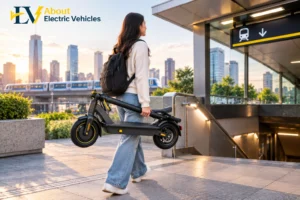
For commuting, think beyond range. Your scooter should be easy to fold, carry, park, and charge. If you take public transportation, weight and folded size may matter more than a very large battery. If you ride the entire route, range, tires, brakes, and comfort become more important.
Maintenance and Storage
A foldable scooter needs regular checks because the folding joint is used repeatedly. Inspect the latch, hinge area, fasteners, tires, brakes, lights, and visible cables. Keep pneumatic tires at the pressure recommended by the manufacturer. Clean the scooter without exposing electrical components to unnecessary water.
When storing the scooter for a long period, follow the manufacturer’s battery-storage instructions. Avoid leaving the scooter in extreme temperatures or a location unsuitable for its battery. If the folding mechanism develops play, cracks, or damage, do not continue riding until it has been inspected and repaired.
New or Used Foldable Electric Scooter?
A used scooter can save money, but portability does not reduce the importance of condition. Inspect the folding joint carefully. Test whether it locks properly and whether the steering feels stable. Check the battery’s charging behavior, tire condition, brake response, lights, display, and charger.
Ask about previous repairs and battery replacement. A worn battery can reduce range, while a damaged folding mechanism can create a serious riding problem.
What Should You Check Before Buying?
Start with five questions: How far will I ride? How often will I carry it? Where will I store it? What roads will I use? Where will I charge it?
Then compare:
- Total weight and folded dimensions
- Battery capacity and realistic range
- Motor performance
- Tire type and suspension
- Brake system
- Folding-lock design
- Lights and visibility
- Maximum rider weight
- Charging time
- Warranty and spare-parts support
A current product page can give you specifications, but independent testing and real owner experience can help reveal whether those specifications translate into practical performance.
Who Should Buy a Foldable Electric Scooter?
A foldable electric scooter makes the most sense for people who value compact storage and easy transportation. It can work well for apartment residents, commuters, students, office workers, and riders who combine scooter travel with other transportation.
FAQs About Foldable Electric Scooter
Q.1 Is a foldable electric scooter worth it?
Yes, if easy storage and transportation are important to you. The value depends on whether its weight, range, comfort, and build quality match your routine.
Q.2 Are foldable electric scooters easy to carry?
Some are, but not all. Check actual weight and folded dimensions before buying. A scooter can fold compactly and still be too heavy for frequent carrying.
Q.3 Can I take a foldable electric scooter in a car?
Many can fit in a car, but dimensions vary. Measure the folded scooter and your vehicle’s available space before buying.
Q.4 Does folding affect durability?
A well-designed folding system can be durable, but it is still a moving mechanical component. Regularly inspect the latch and hinge area for looseness or damage.
Q.5 How much range does a foldable electric scooter have?
There is no single range. Battery size, rider weight, speed, terrain, weather, tires, and riding style all affect actual distance.
Q.6 Can I charge a foldable electric scooter overnight?
It is better to follow the manufacturer’s charging instructions and CPSC guidance. CPSC specifically advises being present while charging and not charging while sleeping or away.
Conclusion
A foldable electric scooter can make powered travel much easier when portability is a real part of your daily routine. The best model is not simply the one with the smallest folded size or highest advertised range. Focus on the complete package: carrying weight, folded dimensions, locking mechanism, battery, realistic range, motor performance, tires, brakes, comfort, charging, and service support. Check local laws before riding and follow safe charging practices.
Choose a scooter that fits the way you actually travel every day. If you can comfortably carry, store, charge, and ride it, the folding design becomes a practical advantage rather than just another feature in the specification list.