
A battery electric bus, often called a BEB, uses electricity stored in a rechargeable battery to power its drive system. Unlike a diesel bus, it does not use an internal-combustion engine as its main source of propulsion. Electricity from the grid is stored in the battery and later used by an electric motor to move the vehicle.
Their success depends on more than the bus itself. Operators must match battery capacity, route demands, charging equipment, electrical infrastructure, maintenance, and schedules.
What Is a Battery Electric Bus?
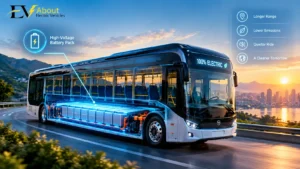
A battery electric bus is an all-electric vehicle that stores energy in a high-voltage battery pack. The battery supplies electricity to the propulsion system, while power electronics control how energy reaches the motor. The bus can also recover some energy while slowing down. Regenerative braking converts part of the vehicle’s motion into electrical energy and sends it back to the battery.
Because a BEB has no tailpipe, it produces no tailpipe emissions while driving. However, electricity generation and battery production still have environmental impacts, so it is more accurate to describe it as a zero-tailpipe-emission vehicle rather than a vehicle with no environmental footprint.
How Does a Battery Electric Bus Work?
The battery stores electrical energy in chemical form. When the driver accelerates, the vehicle’s power electronics control electricity flowing from the battery to the electric motor. The motor converts that electrical energy into mechanical power that turns the wheels.
A battery electric bus also contains systems for battery monitoring, thermal management, charging, braking, steering, climate control, and passenger operation.
Battery Capacity and Energy Use
Battery capacity is commonly measured in kilowatt-hours, or kWh. A higher capacity generally means more stored energy, but it does not automatically guarantee a specific driving range. Energy consumption changes with route conditions. Passenger load, traffic, road grade, speed, weather, heating, air conditioning, and stop frequency can all affect how much energy a bus uses.
How Far Can a Battery Electric Bus Travel?
There is no single range that applies to every battery electric bus. Different models have different battery sizes, vehicle weights, efficiency levels, and operating characteristics. A bus traveling on a flat route with moderate loads may use less energy than the same vehicle climbing hills in cold weather with heavy passenger demand. Heating and air conditioning can also increase energy consumption.
Operators should therefore avoid planning routes around the maximum advertised range alone. A practical plan should leave enough usable energy for traffic, weather changes, route variation, and operational needs.
Charging a Battery Electric Bus
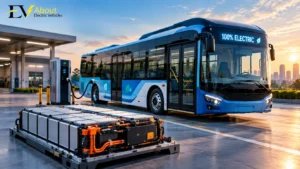
Charging is a central part of BEB operation. Most buses use dedicated electric vehicle supply equipment, or EVSE, to transfer electricity from the grid into the vehicle. Depot charging is common when buses return to a facility for several hours. A lower-power charger may be suitable when the available parking period is long.
Opportunity charging can add energy during the operating day. It may be used at terminals or other planned stops when a bus has enough dwell time.
Charging Time and Power
Charging time depends on battery size, charger output, starting state of charge, vehicle charging limits, temperature, and the amount of energy required. DOE guidance notes that Level 2 charging can provide roughly 5 to 20 miles of range per hour for a battery electric bus, while DC fast charging can provide much more power. The appropriate choice depends on the available dwell period and energy requirement.
A high-power charger is not automatically better. If a bus remains parked overnight, slower charging may provide all the energy needed without requiring unnecessary electrical capacity.
Charging Infrastructure
A battery electric bus fleet needs infrastructure beyond the charger. A depot may require transformers, electrical panels, wiring, protection equipment, communications, software, and construction work. The utility connection must be reviewed before installation. Multiple buses charging at the same time can create substantial peak power demand.
Smart Charging
Smart charging manages when buses receive electricity instead of allowing every vehicle to charge at maximum power immediately. A charging management system can prioritize buses according to departure time, battery state, route requirements, and available electrical capacity. This can help reduce simultaneous peak demand and make better use of the site’s power connection.
Smart charging becomes especially useful when many buses return to the depot around the same time. The system should always protect the main operational requirement: each scheduled bus needs sufficient energy before departure.
Performance in Urban Service
Electric motors can provide strong torque from low speed, which suits stop-and-go transportation. Smooth acceleration can be useful when leaving bus stops and intersections.
Regenerative braking can recover some energy during repeated deceleration. Urban routes with frequent stops may therefore provide opportunities to recover energy that would otherwise be lost as heat through conventional braking. Actual performance still depends on passenger load, road grade, weather, battery state, vehicle design, and driving conditions.
Battery Electric Bus Maintenance
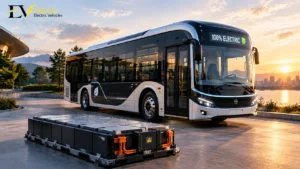
A battery electric bus still needs regular maintenance. Tires, brakes, suspension, steering, doors, cooling systems, electrical components, and other vehicle systems require inspection and service.
Electric propulsion removes some engine-related maintenance tasks because there is no conventional engine oil system or exhaust after-treatment system. However, the high-voltage battery, electrical components, and charging equipment require technicians with appropriate training.
DOE fleet guidance shows that maintenance should be included when evaluating total ownership costs. Scheduled maintenance can remain predictable, while unscheduled repairs and parts availability need to be monitored over the vehicle’s life.
Battery Life and Degradation
A battery does not remain at its original capacity forever. Usable capacity can decline with age and use. Battery life depends on factors such as chemistry, temperature, charging patterns, operating conditions, and manufacturer design. A bus may continue operating as the battery ages, but reduced capacity can affect available range.
Fleet operators should monitor battery performance and follow the manufacturer’s charging, storage, inspection, and maintenance requirements. Warranty terms are also important because they define the manufacturer’s coverage for the battery and related components.
Cost of a Battery Electric Bus
The purchase price of a battery electric bus can be higher than a conventional bus, and the complete project may also require charging infrastructure and electrical upgrades. However, purchase price is only one part of the financial picture. Electricity, maintenance, financing, charging equipment, facility changes, training, insurance, and other operating expenses all affect total cost of ownership.
An electric bus can have lower energy or maintenance costs in some applications, but the result depends on local electricity prices, route conditions, vehicle utilization, and infrastructure costs. Operators should calculate the full lifecycle cost rather than assuming savings.
Environmental Benefits
The biggest environmental advantage is the absence of tailpipe emissions during operation. This can reduce direct exhaust pollution along roads and around passenger loading areas.
Even so, replacing a combustion-powered bus with a battery electric model can change where emissions occur and can reduce local tailpipe pollution. The size of the overall benefit depends on the electricity source and how the vehicle is used.
Battery Electric Bus Safety
High-voltage systems require specific safety procedures. Drivers, technicians, emergency responders, and other relevant personnel need training appropriate to their roles. FTA guidance recommends training on battery charging hazards, high-voltage systems, emergency procedures, regenerative braking, thermal events, isolation of electrical components, and related safety practices.
Charging areas should also provide safe vehicle movement, protected equipment, clear access, and appropriate procedures for damaged vehicles or charging equipment.
Challenges to Consider
BEB adoption also has challenges. Initial vehicle costs can be significant, and charging infrastructure may require construction or utility upgrades. Range planning must account for real operating conditions rather than ideal specifications. Cold or hot weather, heavy passenger loads, hills, and high use of climate control can increase energy demand.
Workforce preparation is another consideration. Technicians may need high-voltage training, while drivers and emergency personnel need procedures suited to electric buses.
How to Choose the Right Model
Start by studying the route. Record daily mileage, passenger demand, hills, traffic, weather, operating hours, and charging opportunities. Then compare usable battery capacity, energy consumption, passenger capacity, charging capability, warranty coverage, service support, safety systems, and expected operating life.
The bus and charging system should be treated as one project. FTA procurement guidance recommends considering vehicle requirements, charging infrastructure, maintenance, training, and long-term fleet needs together. The best battery electric bus is not necessarily the one with the biggest battery. It is the vehicle that can reliably complete its duty cycle with a practical charging and maintenance plan.
FAQs About Battery Electric Bus
Q.1 What is a battery electric bus?
It is a bus powered by electricity stored in a rechargeable battery. The battery supplies energy to an electric motor instead of a conventional combustion engine.
Q.2 How far can a battery electric bus travel?
Range varies by model, battery capacity, route, passenger load, weather, speed, and climate-control use. Real-world testing is more useful than relying only on an advertised maximum.
Q.3 How long does it take to charge?
Charging time depends on battery size, charger power, starting battery level, and vehicle limits. Overnight charging can take several hours, while high-power systems can restore energy faster.
Q.4 Are battery electric buses expensive?
The upfront cost can be higher than conventional buses, and charging infrastructure adds to the project. Operating costs may be lower in some applications, so total lifecycle cost is more important than purchase price alone.
Q.5 Do battery electric buses work in cold weather?
Yes, but cold conditions can affect energy consumption and battery performance. Route planning should account for local temperatures and heating requirements.
Q.6 Are battery electric buses safe?
Yes, when vehicles, charging systems, facilities, maintenance procedures, and staff training are properly managed. High-voltage systems require appropriate safety practices. FTA provides safety and certification guidance for battery-electric bus fleets.
Conclusion
A battery electric bus is more than a conventional bus with a different power source. It is part of an integrated system that includes the battery, electric drive, charging equipment, electrical infrastructure, route schedule, maintenance program, and trained workforce. The strongest fleet decisions begin with real operating data. Operators should understand daily energy needs, charging windows, passenger loads, climate, infrastructure limits, and long-term costs before selecting a vehicle.
When the bus and its supporting systems are planned together, battery electric technology can provide dependable transportation, zero tailpipe emissions, regenerative braking, and potentially lower operating costs. The key is choosing a configuration that matches the actual work the bus must perform.