
If you ride an electric scooter every day, your battery is everything. It decides how far you can go, how strong your scooter feels on hills, and how many years your scooter will serve you before range starts to shrink. That is why electric scooter battery life is one of the most searched topics among scooter owners and buyers.
Scooter batteries live a hard life: they are small, they are drained deeply by daily commuting, and they sit inside a deck that faces rain, dust, and bumps. The good news is that with the right habits, a modern lithium battery lasts far longer than most riders expect. In this guide, we explain the real electric scooter battery life, what shortens it, and how to get the maximum life out of your pack.
How Long Is Electric Scooter Battery Life on Average?
For most models, electric scooter battery life is around 2 to 5 years, or roughly 300 to 800 full charge cycles, before capacity falls to about 80 percent of the original. In distance terms, that is approximately 3,000 to 15,000 miles of riding.
Premium commuter scooters from brands like Segway Ninebot, Xiaomi, Dualtron, and Kaabo use quality cells from Samsung, LG, or Panasonic and reach the top of that range. Budget scooters with generic cells, small 250–350Wh packs, and heavy daily use usually land closer to 2 to 3 years.
Battery size is the big factor: a scooter with a 500Wh or larger pack works less hard on every trip than a small 250Wh model, so it ages more slowly. High-performance dual-motor scooters carry packs of 1,000Wh or more and can last impressively long if ridden sensibly. Remember, at 80 percent capacity a battery is not dead — your scooter simply has less range, and many riders keep using it for a long time after that.

What Affects Electric Scooter Battery Life?
Scooter batteries age for predictable reasons. Understanding them helps you protect the most valuable part of your scooter.
Deep daily discharge. Commuters often ride the battery nearly empty and recharge it fully every day. Deep cycles wear lithium cells faster than shallow ones, and small packs suffer the most.
Heat and cold. A scooter stored in a hot car trunk, a sun-baked balcony, or a freezing garage ages quickly. Heat speeds up chemical degradation, and charging a cold-soaked battery can cause lasting damage.
Water and road grime. The battery lives low in the deck, close to puddles and spray. Riding through deep water can let moisture reach the pack over time.
Riding style and load. Full-throttle starts, sport mode everywhere, steep hills, and heavier riders all pull high current from a small battery, which increases cell stress.
Tire pressure and maintenance. Soft tires make the motor work harder on every ride, draining the battery deeper for the same trip. This hidden factor quietly shortens electric scooter battery life for many owners.
Signs Your Electric Scooter Battery Is Degrading
Degradation creeps up slowly, so compare your scooter with how it performed when new. The first sign is reduced range: a commute that once used half your battery now nearly empties it. You may also notice weaker hill climbing, top speed dropping earlier in the ride, or the battery percentage falling in sudden jumps instead of smoothly.
Charging behavior changes too. A pack that charges suspiciously fast to “full” often has lost capacity, while one that becomes warm or takes far longer than usual may have a failing cell group. Many scooters show cycle counts or battery health in their companion app.
A healthy pack should still hold around 80 to 85 percent of its original capacity after a few years. Swelling of the deck, a battery that gets hot, error codes, or a scooter that will not charge at all are safety warnings — stop riding and contact the manufacturer or a qualified repair shop.
How to Extend Electric Scooter Battery Life
You cannot stop battery aging, but you can slow it dramatically. These habits will maximize electric scooter battery life:
- Avoid full charges and empty batteries daily. Charge to around 80–90 percent for commuting, and save 100 percent for long rides. Do not let the pack sit at 0 percent.
- Charge little and often. Topping up after short trips is gentler than one huge deep cycle, because partial charges stress the cells less.
- Store at 40–60% charge. If the scooter will sit for weeks, park it at partial charge in a cool, dry indoor spot — never full, never empty.
- Keep tires properly inflated. Correct pressure reduces motor load, extends range per charge, and reduces depth of discharge on every trip.
- Ride smoothly in Eco or standard mode. Gentle acceleration and moderate speeds cut current stress and heat.
- Protect it from water. Avoid deep puddles, do not pressure wash the deck, and dry the scooter after wet rides. Check your model’s IP rating.
- Use only the original charger. The correct voltage and charging profile protect both the cells and the battery management system.
Commuters who follow these basics regularly report strong range after three or more years of daily riding, which shows how much daily habits extend electric scooter battery life.
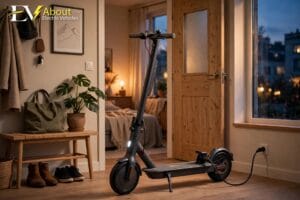
Charging Habits That Protect Battery Health
Most scooter battery wear happens during charging, and most of it is avoidable. Let the battery cool down and reach room temperature before plugging in — charging straight after a hard, hot ride adds stress.
Once charging finishes, unplug the scooter rather than leaving it connected for days; sitting at 100 percent for long periods speeds up aging, even though the charger stops adding power. Never charge a visibly damaged or swollen battery. If your scooter or app offers a charge limit or battery care mode, switch it on. These small routines quietly protect electric scooter battery life without changing your routine at all.
Electric Scooter Battery Warranties: What Is Covered?
Battery warranties are the weak spot of the scooter market, so read them carefully before buying. Many brands cover the battery for only 6 months to 2 years, often shorter than the warranty on the frame or motor. Premium brands usually offer 1 to 2 years on the battery with conditions about capacity and correct charging.
Check three things: the warranty period for the battery specifically (not the whole scooter), what capacity percentage is guaranteed, and whether replacement batteries for your model are actually sold by the brand. A clear battery warranty and available spares are strong signs of confidence in real-world electric scooter battery life — and worth paying a little extra for.
How Much Does an Electric Scooter Battery Replacement Cost?
Replacement cost depends on capacity and brand. A small pack for an entry-level commuter scooter typically costs between $100 and $300. Mid-range packs of around 500Wh usually run from $300 to $600, while the large batteries in high-performance dual-motor scooters can cost $800 to $1,500 or more.
There is a catch: on many scooters the battery is built into the deck and is not designed to be user-replaceable, so labor at a repair shop adds to the bill, and some models cannot be serviced at all. A growing number of independent repair shops can rebuild packs, which can be cheaper than a new battery. Choosing a model with a replaceable battery protects you later.
Common Myths About Electric Scooter Batteries
Myth 1: Leaving the scooter plugged in keeps the battery “topped up and healthy.” False. Sitting at 100 percent for days accelerates aging. Unplug when charging is done.
Myth 2: You should fully drain the battery before every charge. False. Lithium batteries have no memory effect. Deep discharges are actually the most wearing pattern of all.
Myth 3: Rain riding destroys the battery instantly. Most scooters carry an IP water-resistance rating for normal rain. The real risks are deep puddles, submersion, and pressure washing, not ordinary wet roads.
FAQs About Electric Scooter Battery Life
How many years does an electric scooter battery last?
Most electric scooter batteries last 2 to 5 years. Premium models with quality cells and gentle charging habits reach the top of that range, while small budget packs used hard every day sit at the lower end.
How many charge cycles does a scooter battery get?
Expect roughly 300 to 800 full charge cycles before capacity drops to about 80 percent. Partial charges count as partial cycles, so topping up little and often extends total battery lifespan.
Can an electric scooter battery be replaced?
On many models, yes — either as a simple swap or through a repair shop. On some budget scooters the pack is sealed into the deck and replacement is difficult or impossible, so check before you buy.
Why is my scooter’s range getting shorter?
Usually it is normal degradation combined with one or more habits: daily deep discharge, low tire pressure, cold weather, or storing the scooter fully charged. Cold weather alone can temporarily cut range by 20 percent or more.
Should I charge my scooter after every ride?
For short rides, topping up is fine and healthy for the battery. Just avoid charging to 100 percent every time if your scooter offers a charge limit — 80 to 90 percent is ideal for daily use.
Is a used electric scooter a risky buy?
Check the battery above everything else. Test ride it on your typical route, compare real range with the original specification, and ask about charge cycles in the app if available. A healthy battery makes a used scooter a bargain.

Conclusion
Electric scooter battery life is better than most people think — and worse when the battery is neglected. A typical pack delivers 2 to 5 years and hundreds of charge cycles, and the difference between the low end and the high end is mostly your habits: charge partially, store at half charge indoors, keep your tires inflated, and protect the deck from water. When buying, favor quality cells, a clear battery warranty, and a model with a replaceable battery you can actually buy later. Treat the battery well, and your scooter will keep its range, its punch, and its value for years of cheap, easy riding.