
“How long does it take to charge?” is the first question every new EV driver asks — and the honest answer is: it depends. Electric car charging time can be anything from 20 minutes at a fast charger to two full days on a basic wall socket. What matters is the charger you use, the size of your battery, and how full it already is.
Once you understand those three things, charging stops being a mystery and becomes the easiest part of EV ownership — most drivers simply plug in at home and wake up to a full battery every morning. In this guide, we break down the real electric car charging time for every charging method, popular models, and the tricks that make charging faster.
Electric Car Charging Time by Charger Type
There are three levels of charging, and the gap between them is enormous.
Level 1 — regular wall socket (1.4–2.4 kW).
The slowest option, adding roughly 3 to 5 miles of range per hour. A full charge for a typical 60 kWh battery takes 40 to 50 hours. Level 1 is fine for plug-in hybrids, very short commutes, or as a backup, but it is too slow as the only method for most EV drivers.
Level 2 — home wallbox and public AC chargers (7–22 kW).
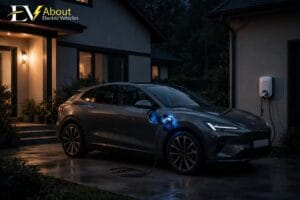
This is the everyday standard. A 7 kW home charger adds about 25 to 30 miles of range per hour and charges most EVs fully in 6 to 10 hours — plug in at night, wake up full. Public Level 2 chargers at workplaces and hotels work the same way.
DC fast charging (50–350 kW).
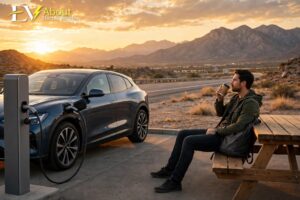
Built for road trips, fast chargers add 100 to 200 miles of range in about 20 to 30 minutes. They charge from 10 to 80 percent quickly, then slow down sharply to protect the battery. The fastest models on 800-volt systems can do 10 to 80 percent in as little as 18 minutes. This is the electric car charging time people picture at motorway stops — barely longer than a coffee break.
Charging Times for Popular Electric Cars
Manufacturer figures below are approximate and assume ideal conditions; real-world times vary with temperature and charger condition.
- Tesla Model 3 Long Range: ~25–30 minutes (10–80%) on a Supercharger; ~8 hours on a 7 kW home charger
- Tesla Model Y: ~27–30 minutes (10–80%) at up to 250 kW; ~8–9 hours at home
- Hyundai Ioniq 5 / Kia EV6: ~18 minutes (10–80%) on a 350 kW charger — among the fastest charging EVs sold
- Volkswagen ID.4: ~28–33 minutes (10–80%) DC fast charging; ~7.5 hours at home
- Ford Mustang Mach-E: ~36–45 minutes (10–80%) DC; ~9–10 hours at home
- Nissan Leaf: ~40–60 minutes on a 50 kW CHAdeMO charger; ~7 hours at home
- Chevrolet Bolt EV: ~60–70 minutes (10–80%) — its 55 kW charging limit makes it one of the slower fast chargers
- Porsche Taycan / Audi e-tron GT: ~22 minutes (5–80%) on an 800-volt charger
The lesson: the advertised peak charging speed matters far less than how long the car holds a high speed. Two cars on the same charger can differ by 20 minutes.
What Affects Electric Car Charging Time?
Battery size.
Energy in takes time: a 100 kWh pack needs roughly twice as long as a 50 kWh pack on the same charger. Bigger batteries usually accept higher charging power to compensate.
The charger’s power — and your car’s limit.
Charging runs at the slower of the two. Plug a car that accepts 100 kW into a 350 kW charger and you still get 100 kW. On AC charging, the car’s onboard charger is the limit — many models cap at 7 or 11 kW no matter what the wallbox offers.
State of charge — the charging curve.
Batteries charge fastest when nearly empty and slow progressively as they fill, especially after 80 percent. That final 20 percent can take as long as the first 80. This is why road-trippers charge to 80 percent and go — fighting the curve wastes time on every stop.
Temperature.
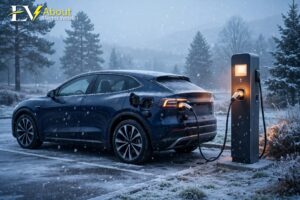
A cold battery charges slowly, sometimes at half speed, until it warms up. Most modern EVs offer battery preconditioning: while navigating to a fast charger, the car heats the pack so you arrive ready for full speed. Using it can cut your electric car charging time on a winter stop by 10 minutes or more.
Battery age and health.
Older, degraded packs and unbalanced cells accept charge more slowly. It is one more reason the charging habits in our battery life guide matter.
A Simple Formula to Estimate Your Charging Time
You can estimate any electric car charging time with one simple calculation:
Charging time = energy needed (kWh) ÷ charger power (kW)
Say your car has a 60 kWh battery and you are charging from 20 to 100 percent. That is 80 percent of 60 kWh — 48 kWh to add. On a 7 kW home charger: 48 ÷ 7 ≈ 7 hours. On a 150 kW fast charger, the maths suggests about 20 minutes, and real life adds a little more because of the charging curve — expect 25 to 30 minutes for 20 to 80 percent, then a slower finish.
This formula is the quickest way to sanity-check any advertised electric car charging time. If a seller promises a full charge in an hour on a home socket, the numbers will expose it instantly: a wall socket delivers about 2 kW, and 2 kW cannot fill a 60 kWh battery in anything like an hour.
How to Charge Faster: Practical Tips
You cannot change your car’s hardware, but you can almost always cut your waiting time:
- Charge between 10 and 80 percent on road trips. Two short stops beat one long one almost every time.
- Precondition the battery — always navigate to the charger using the car’s built-in route planner so the pack is at the ideal temperature when you arrive.
- Pick the right charger. Use the fastest charger your car can actually exploit; a 350 kW unit is wasted on a 50 kW car, and slower chargers are often cheaper.
- Arrive low. Rolling in at 10 percent charges far faster than topping up from 60 percent.
- At home, install a Level 2 wallbox. It turns electric car charging time into a non-issue: every morning starts with a full battery.
- Charge overnight on off-peak rates where your utility offers them — the same hours, at a fraction of the cost.
Does Fast Charging Damage the Battery?
This is the most common worry attached to electric car charging time, and modern data is reassuring. Occasional DC fast charging — road trips, busy weeks — has only a small effect on long-term battery health, because the car’s battery management system controls temperature and charging speed precisely to protect the cells. Studies of high-mileage fleets show only slightly faster degradation in cars fast-charged very frequently compared with those charged mostly at home.
The sensible approach is balance: use Level 2 charging for daily life, save DC fast charging for when you need the speed, and avoid charging to 100 percent and letting the car sit full for days. Do that, and charging speed will never be a trade-off against battery life.
Home vs. Public Charging: Which Is Better?
For daily driving, home charging wins on every metric except raw speed — it is the cheapest per mile, the most convenient, and the gentlest on the battery. The “charging time” is your sleep. Public Level 2 suits drivers without home parking, and DC fast charging is the road-trip tool: more expensive per kWh, but it buys you hundreds of miles in the time a coffee takes. Most experienced owners mix all three without thinking about it — the car charges where it parks, and fast chargers only enter the story a few times a year.
FAQs About Electric Car Charging Time
Q.1 How long does it take to charge an electric car at home?
On a typical 7 kW home wallbox, most EVs charge fully in 6 to 10 hours — easily done overnight. On a standard wall socket (Level 1), a full charge can take 40 to 50 hours, which suits only very light use.
Q.2 How long does a Tesla take to charge?
On a Supercharger, a Model 3 or Model Y goes from 10 to 80 percent in about 25 to 30 minutes. A full charge at home on a wall connector takes roughly 8 to 10 hours.
Q.3 Why does charging slow down after 80 percent?
To protect the battery. As cells fill, the car reduces charging power to prevent overheating and excess wear — this is called the charging curve. On a road trip, unplugging at 80 percent and driving to the next stop is faster than waiting for 100 percent.
Q.4 What is the fastest charging electric car?
Cars with 800-volt systems — such as the Hyundai Ioniq 5, Kia EV6, Porsche Taycan, and Lucid Air — lead the field, adding 10 to 80 percent in roughly 18 to 23 minutes on a suitable high-power charger.
Q.5 Can I charge an electric car in the rain?
Yes. Chargers and connectors are sealed and weatherproofed, and charging in rain is completely safe and normal. The system only starts delivering power after a secure, checked connection is established.
Q.6 How much does it cost to charge an electric car?
It depends on where you charge. Home charging on off-peak rates is the cheapest — often just a few dollars for a full battery. DC fast charging costs more per kWh but is still usually cheaper per mile than petrol or diesel.
Conclusion
Electric car charging time is not one number — it is a range from about 20 minutes to overnight, and you choose where on that range you live. With a home wallbox, charging disappears into the background entirely; with modern fast chargers and an 800-volt car, even long road trips need only coffee-length stops. Understand your charging curve, precondition in winter, charge to 80 percent on the road, and the clock will never be the reason to hesitate about going electric. For most drivers, the real answer to “how long does it take?” turns out to be simple: less time than you spend filling a fuel tank each week — because it happens while you sleep.