
An electric motorcycle motor is one of the most important parts of an electric motorcycle. It converts electrical energy from the battery into mechanical power that moves the motorcycle. The motor has a direct impact on acceleration, hill-climbing ability, efficiency, throttle response, and overall riding experience.
However, choosing an electric motor is not as simple as selecting the highest wattage available. Motor performance depends on several factors, including torque, battery voltage, controller settings, motor efficiency, cooling, motorcycle weight, and riding conditions. A motor that works well for daily city commuting may not be the right choice for steep roads or performance riding. Understanding how an electric motorcycle motor works can therefore help you choose an electric motorcycle that better matches your needs.
What Is an Electric Motorcycle Motor?
An electric motorcycle motor is an electric drive unit that converts electrical energy into rotational movement. In an electric motorcycle, the battery supplies electricity to the motor through an electronic controller. The controller regulates how much power reaches the motor based on inputs such as throttle position, riding mode, speed, and other system parameters.
The basic process is:
Battery → Controller → Motor → Rear Wheel
The exact power-transfer system depends on the motorcycle’s design. Some electric motorcycles use a motor integrated into the wheel hub, while others use a centrally mounted motor connected to the rear wheel through a chain, belt, or another drivetrain system.
The motor is only one part of the complete powertrain. Battery capacity, controller programming, cooling, drivetrain design, and vehicle weight all influence how the motorcycle performs in real-world conditions.
Types of Electric Motorcycle Motors
Electric motorcycles can use different motor designs and layouts. Two important configurations to understand are hub motors and centrally mounted motors.
Hub Motor
A hub motor is integrated into the motorcycle’s wheel hub. Instead of using a separate motor and conventional drivetrain to transfer power to the wheel, the motor produces rotational force directly at the wheel. One advantage of this design is its relatively simple mechanical layout. Because fewer traditional drivetrain components may be required, the system can offer quiet and straightforward power delivery.
Hub motors can provide:
- Direct power delivery
- Simple mechanical construction
- Quiet operation
- Fewer traditional drivetrain components
- Potentially lower mechanical maintenance
However, there is an important trade-off. Because the motor is part of the wheel assembly, it adds weight to the wheel. This can affect suspension response and handling, particularly on motorcycles designed for aggressive or sporty riding. The motor also needs sufficient cooling because continuous high-power operation can generate significant heat.
Centrally Mounted Motor
A centrally mounted motor sits closer to the center of the motorcycle rather than inside the wheel. Power is generally transferred to the rear wheel through a chain, belt, or similar drivetrain.
Keeping the motor closer to the center can help with weight distribution and overall handling. This configuration can be useful for electric motorcycles designed for performance, hilly terrain, or demanding riding conditions. The exact advantages depend on the motorcycle’s engineering, but central motor placement can provide a balanced approach to power delivery, handling, and drivetrain design.
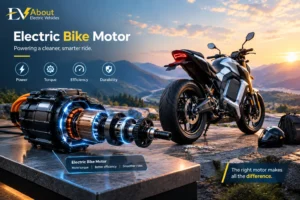
Electric Motorcycle Motor Watts Explained
Motor power is usually measured in watts (W) or kilowatts (kW). A higher power rating generally indicates that the motor can produce more power under suitable operating conditions. But wattage does not tell the entire story.
The real-world performance of an electric motorcycle also depends on:
- Motor torque
- Battery voltage
- Controller output
- Motor efficiency
- Cooling system
- Motorcycle weight
- Wheel size
- Aerodynamics
- Riding conditions
For example, a high-powered motor can provide strong acceleration, but it may consume more energy when used aggressively. A lower-powered motor can still be perfectly suitable for a lightweight commuter motorcycle if it provides adequate torque and is properly matched with the battery and controller. This is why you should never choose an electric bike motor based only on its wattage number.
What Is Motor Torque?
Torque is rotational force and is measured in Newton-metres (Nm). For an electric motorcycle, torque is especially important when accelerating from a stop, climbing hills, or carrying additional weight.
Imagine two electric motorcycles with similar motor power. If their torque delivery and controller tuning are different, they can feel very different when you open the throttle. A motor with strong torque can provide quick initial acceleration and useful climbing ability. Torque is also important when the motorcycle carries a passenger, luggage, or other additional weight.
Power and torque are related but are not the same measurement. Torque describes rotational force, while power describes the rate at which work can be performed. If you frequently ride on steep roads, torque should be one of the specifications you pay close attention to.
The Role of the Motor Controller
The motor controller is the electronic component that manages the flow of electricity between the battery and motor. It has a major influence on how an electric motorcycle feels while riding.
Controller programming can affect:
- Throttle response
- Acceleration
- Maximum power
- Riding modes
- Regenerative braking
- Energy consumption
- Motor protection
A well-tuned controller can provide smooth and predictable acceleration. An aggressive controller setup may provide a sharper response but can also increase energy consumption. This means that two motorcycles using motors with similar specifications can still deliver noticeably different riding experiences.
How to Choose the Right Electric Motorcycle Motor
The right electric motorcycle motor depends on how you intend to use your electric motorcycle.
For City Commuting
For everyday urban riding, an extremely powerful motor may not be necessary.
Instead, look for a balanced system with:
- Smooth acceleration
- Adequate torque
- Good efficiency
- Reliable cooling
- Compatible battery capacity
- Predictable throttle response
City riding often involves repeated acceleration and braking, so efficiency can be just as important as peak power.
For Steep Hills
Steep roads place greater demands on the motor. If you regularly ride through hilly areas, pay particular attention to torque and sustained motor performance. The motor must produce enough force to climb efficiently without excessive heat buildup.
Do not judge hill-climbing ability by wattage alone. Motorcycle weight, battery capability, controller limits, motor efficiency, and riding speed also matter.
For Heavy Loads
Carrying a passenger, luggage, or equipment increases the total weight the motor has to move. In this situation, consider torque, battery capacity, cooling, brakes, tires, and overall vehicle specifications alongside motor power. A motor that feels powerful with a lightweight load may behave differently when the motorcycle is heavily loaded.
For Performance Riding
Performance-oriented electric motorcycles require a powertrain capable of delivering higher output. Peak motor power, torque, battery discharge capability, controller programming, cooling, and drivetrain strength all become important. A powerful motor is useful only when the battery, controller, and rest of the powertrain can support it properly.
How the Motor Affects Battery Range
Motor performance and battery range are closely connected, but motor wattage alone does not determine how far an electric motorcycle can travel.
Energy consumption can be affected by:
- Battery capacity
- Motor efficiency
- Riding speed
- Motorcycle and rider weight
- Passenger or cargo weight
- Terrain
- Wind
- Tire pressure
- Acceleration
- Riding mode
- Temperature
- Stop-and-go traffic
Aggressive acceleration and sustained high-speed riding generally consume more energy than moderate riding. For this reason, the motor and battery should be considered as a complete system. A high-output motor paired with a relatively small battery may provide strong acceleration but limited range during demanding use.
Does a More Powerful Motor Mean a Faster Electric Motorcycle?
Not necessarily. Top speed depends on several factors, including motor power, controller settings, battery voltage, final-drive ratio, wheel size, aerodynamics, motorcycle weight, and manufacturer limitations. A more powerful motor can improve acceleration and hill-climbing performance without necessarily increasing top speed by the same proportion.
Instead of simply choosing the most powerful motor, consider what type of performance you actually need. A commuter may prioritize efficiency and smooth operation, while a performance rider may place more importance on acceleration and sustained power.
Electric Motorcycle Motor Maintenance
Electric motors generally require less routine mechanical maintenance than internal-combustion motorcycle engines, but the complete electric motorcycle still needs regular care.
Inspect electrical cables and connectors for visible damage or looseness. Keep the motor area clean and follow the manufacturer’s recommendations regarding water exposure and cleaning. If the motorcycle uses a chain or belt drive, maintain it according to the recommended service schedule. Tires, brakes, wheels, suspension, and other components also need regular inspection.
Pay attention to warning signs such as:
- Unusual motor noise
- Excessive heat
- Sudden power loss
- Intermittent acceleration
- Unusual vibration
- Electrical faults
If these symptoms appear, have the motorcycle inspected before continuing to use it normally.
How Long Does an Electric Motorcycle Motor Last?
There is no universal lifespan for every electric motorcycle motor. Motor durability depends on factors such as construction quality, operating temperature, load, maintenance, riding environment, water exposure, and how frequently the motor operates near its maximum output.
A properly designed motor that is used within its intended operating conditions can provide years of service. Excessive heat, heavy loads, poor maintenance, and repeated high-output operation can increase stress on the system. The motor should therefore be considered part of the complete electric motorcycle powertrain rather than an isolated component.
Common Mistakes When Choosing an Electric Motorcycle Motor
Choosing Watts Over Everything Else
A large wattage number may look impressive, but it does not tell you how the motorcycle will perform in every situation. Consider torque, efficiency, battery capability, controller settings, and cooling as well.
Ignoring Torque
Torque has a major effect on acceleration and hill climbing. If you regularly ride on steep roads or carry additional weight, torque deserves serious attention.
Ignoring the Battery
A powerful motor needs an electrical system capable of supplying the required energy. Always consider motor and battery specifications together.
Buying More Power Than You Need
Extra power can add cost, weight, and energy consumption. Choose a motor according to your actual riding requirements instead of simply selecting the largest specification.
Ignoring Service Availability
Before buying an electric motorcycle, check whether replacement parts, diagnostic support, and qualified technicians are available for the motor and electrical system.
Frequently Asked Questions
Q.1 What is the best electric motorcycle motor?
There is no single motor that is best for every electric motorcycle. The right motor depends on your riding conditions, required performance, motorcycle weight, battery capacity, and intended use.
Q.2 Is a higher-wattage electric motor better?
Not automatically. Higher power can provide stronger performance, but torque, controller settings, battery capability, efficiency, cooling, and vehicle weight also affect real-world results.
Q.3 Is torque important on an electric motorcycle?
Yes. Torque is particularly important for acceleration from a stop, climbing hills, and carrying additional weight.
Q.4 Does a powerful motor reduce battery range?
A powerful motor can consume more energy when operated aggressively, but range depends on many factors, including battery capacity, speed, terrain, weight, riding style, temperature, and motor efficiency.
Q.5 How should an electric motorcycle motor be maintained?
Follow the manufacturer’s maintenance schedule, inspect electrical connections, watch for unusual heat or noise, and maintain the motorcycle’s drivetrain, tires, brakes, and wheels as recommended.
Q.6 How do I choose the right electric bike motor?
Start with your typical riding conditions. Consider city commuting, hills, passenger or cargo weight, desired acceleration, battery range, torque, power, cooling, and service availability before choosing a motor.
Conclusion
Choosing the right electric motorcycle motor for an electric motorcycle is not simply about finding the biggest wattage number. The right motor is the one that matches the motorcycle’s intended use, battery, controller, weight, and riding conditions. Motor power affects overall performance, while torque plays an important role in acceleration and hill climbing. The battery determines how much energy is available, the controller manages power delivery, and the cooling system helps the motor handle demanding conditions.
For city commuting, efficiency and smooth power delivery may be more valuable than extreme output. For steep hills, heavy loads, or performance riding, torque, sustained power, battery capability, and thermal management become increasingly important. Most importantly, evaluate the electric bike motor as part of the complete electric motorcycle system. When the electric bik motor, battery, controller, drivetrain, brakes, tires, and cooling system are properly matched, the result can be a smoother, more efficient, and more enjoyable riding experience.