
Electric Scooter Speed can make commuting quicker and more enjoyable when it matches your needs. But speed is not controlled by the motor alone. Battery voltage, motor output, rider weight, tires, terrain, battery charge, and software limits can all change how quickly a scooter moves.
A manufacturer’s top-speed figure should also be treated as a specification, not a promise of the exact speed you will see on every ride. Independent 2026 testing found that most tested scooters did not reach their advertised top speed under test conditions. This shows why a smart buyer should look beyond one number. This guide explains what makes an electric scooter fast, how to choose the right performance level, why real-world speed can differ, and what safety features matter when speed increases.
What Makes Electric Scooter Speed Different?
Several systems work together to determine speed. The motor supplies driving force, while the battery provides electrical energy. The controller manages how that power reaches the motor. A scooter with a powerful motor can accelerate strongly, but the battery and controller must be able to support it. The scooter also needs suitable tires, brakes, frame strength, and suspension to handle higher speeds.
Rider position and air resistance can also become more noticeable as speed increases. A heavier rider, headwind, rough pavement, or an uphill section can reduce the speed a scooter reaches.
Motor Power and Top Speed
Motor wattage is one of the most visible specifications on a fast scooter. Electric Scooter Speed can benefit from higher power because it can provide stronger acceleration and better performance on hills, but wattage alone does not tell you the exact top speed. Peak power is different from continuous or rated power. Peak output describes what the system can produce for a limited period, while rated output is more representative of sustained operation. When comparing models, look at both instead of choosing solely from the largest watt number.
Battery Voltage and Speed
Battery voltage affects the electrical system’s ability to deliver power. Electric Scooter Speed can be influenced by a higher-voltage system, which is common in performance models because it can support high power demands efficiently. However, a bigger voltage number does not automatically mean a scooter will be faster. Motor design, controller limits, battery current, software settings, rider load, and wheel configuration also matter.
Battery charge can affect performance as well. As the battery voltage falls during use, some scooters may show weaker acceleration or lower top speed, especially under heavy load.
Acceleration vs Top Speed
Top speed and acceleration are not the same thing. A scooter may have a high maximum speed but take longer to reach it. Another model may feel very quick from a stop but have a lower maximum. For city riding, strong acceleration can be more useful than an extreme top-speed figure. It can help you move away from traffic lights and climb moderate slopes without requiring a very high cruising speed. Electric Scooter Speed should therefore be considered alongside acceleration and everyday riding conditions.
If you mainly ride short urban routes, consider how quickly the scooter reaches your normal riding speed instead of focusing only on its maximum number.
Why Advertised Speed Can Be Different
Specifications are usually measured under particular conditions. Rider weight, battery level, temperature, wind, road surface, tire choice, and terrain can all influence the result. Recent GPS-based testing of eight scooters found that seven were slower than their advertised figures, with an average shortfall of about 3.2 mph. This does not mean manufacturer specifications are useless. It means you should understand the conditions behind them and remember that Electric Scooter Speed can vary in real use.
A claimed speed is best viewed as a reference point. Real performance is more useful when it comes from standardized testing or consistent measurements. This matters for daily riders because usable performance is more valuable than a headline specification that only appears under ideal conditions on a controlled test surface.
Tires and Their Effect on Speed
Tires affect rolling resistance, grip, comfort, and stability. Street-oriented tires can behave differently from aggressive off-road tires, particularly on smooth pavement.
Correct tire pressure is also important. Underinflated pneumatic tires can increase rolling resistance and reduce efficiency. Overinflation can reduce comfort and available grip. Follow the pressure guidance supplied for your scooter and tire. Larger tires can also improve stability over uneven surfaces.
Rider Weight and Terrain
A lighter load generally makes it easier for a scooter to accelerate and reach its potential speed. A heavier rider, cargo, or steep hill requires more force from the motor. Flat, smooth pavement is usually the easiest environment for reaching maximum speed. Hills, rough surfaces, strong headwinds, and frequent stops can reduce performance.
This is why two riders can get different results from the same scooter. A speed number from a product page cannot account for every rider and route.
Fast Does Not Always Mean Long Range
High performance can increase energy use. Frequent hard acceleration, high-speed riding, hills, heavy loads, and strong wind can all reduce battery range. Electric Scooter Speed and range therefore need to be considered together.
Manufacturers may publish a maximum range measured under controlled conditions. Real-world range is often lower. A 2026 comparison of 12 scooters found that tested range varied widely against manufacturer claims. If you want both speed and range, consider a larger battery while also considering the scooter’s weight and motor efficiency.
Brakes Become More Important at Higher Speed
A fast scooter needs braking equipment that matches its performance. Electric Scooter Speed makes dependable braking especially important. Hydraulic disc brakes can provide strong, controllable braking on many performance scooters, while mechanical disc brakes may be suitable for lower-performance models. Brake condition matters as much as brake type. Worn pads, damaged rotors, loose cables, or poorly adjusted components can reduce stopping performance. Before riding quickly, check that the brakes respond properly. Give yourself extra stopping distance and avoid assuming that a scooter can stop as quickly as a car.
Suspension and Stability
Suspension can improve control and comfort on uneven roads. It helps the wheels maintain better contact with the surface when the road contains bumps or broken pavement.
How Should You Choose Electric Scooter Speed?
The right speed depends on where and how you ride. A commuter may need only moderate speed for local streets, while a private-road performance rider may want much more. Choose a model based on your actual route rather than buying the fastest machine available.
Speed Modes and Controllers
Many scooters offer several riding modes. Eco or low-power modes reduce acceleration and maximum speed, while sport or performance modes release more of the available output. These settings can help manage Electric Scooter Speed when you want to save energy or make the scooter easier to control in crowded areas.
Safety Gear for Fast Scooters
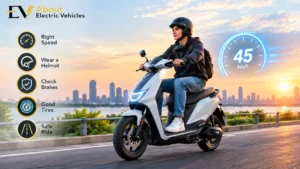
As Electric Scooter Speed rises, protective equipment becomes increasingly important. A properly fitted helmet is essential, and riders using high-performance scooters should consider additional protection such as gloves, eye protection, protective clothing, and appropriate footwear. Inspect the scooter before riding. Check the tires, brakes, steering, lights, fasteners, and frame for problems. Follow the manufacturer’s instructions and local rules.
How to Choose a Fast Electric Scooter
Start by deciding your normal riding speed. Then consider acceleration, motor configuration, battery capacity, brakes, suspension, tires, weight, and build quality. Electric Scooter Speed should match your normal route and riding conditions.
Do not buy a performance scooter simply because its specification sheet has the highest top-speed number. A slightly slower model with better brakes, stable handling, useful range, and available replacement parts may be a much better choice.
Common Mistakes When Buying a Fast Scooter
One mistake is treating advertised top speed as guaranteed real-world performance. Another is ignoring braking and tire quality because the motor specification looks impressive. Some buyers also underestimate weight. A powerful scooter can be difficult to carry upstairs or load into a vehicle.
Buying too much speed is another problem. If your route has low speed limits or crowded paths, extreme performance may add little practical value. Finally, do not modify a scooter simply to increase speed without understanding the effects on the battery, controller, motor, brakes, and warranty. A modification can change the vehicle’s behavior and may create safety or legal issues.
FAQs About Electric Scooter Speed
Q.1 What makes an electric scooter fast?
Motor output, battery voltage, controller settings, wheel and tire design, rider weight, and terrain all affect speed. A strong system needs to work together rather than relying on one specification.
Q.2 Is a dual-motor scooter faster?
Often, yes, especially during acceleration and hill climbing. But dual motors do not automatically guarantee a higher top speed because software and other components can limit performance.
Q.3 Can Electric Scooter Speed reach its advertised level?
Sometimes, but not always. Real speed depends on conditions such as rider weight, battery charge, wind, temperature, tires, and surface. Independent testing is more useful than relying on a claimed figure alone.
Q.4 Does higher wattage always mean more speed?
No. Wattage can indicate available motor power, but top speed depends on the complete electrical and mechanical system.
Q.5 Does riding fast reduce battery range?
Usually. Higher speed and frequent hard acceleration require more energy. Hills, wind, rider weight, and low temperatures can also affect range.
Q.6 Is Electric Scooter Speed safe?
It can be used responsibly, but higher speed increases the consequences of mistakes and hazards. Proper equipment, maintenance, controlled riding, and compliance with local rules are essential.
Conclusion
Electric Scooter Speed that is appropriate for your needs should offer more than a high top-speed number. Motor power, battery voltage, controller behavior, tires, brakes, suspension, rider weight, and terrain all shape real performance. The smartest approach is to choose a speed level that matches your route and local rules. Look for dependable braking, stable handling, quality tires, useful range, and solid construction. Treat advertised speed as a reference rather than a guarantee, and prioritize control over maximum speed.
A fast scooter can be enjoyable and practical when its performance is matched with good engineering and responsible riding. The best model is not necessarily the fastest one; it is the one that gives you the right combination of speed, control, range, reliability, and safety.