
If you are searching for an electric scooter for kids, safety should come before speed, battery size, or appearance. An electric scooter is a motorized vehicle, not simply a toy, and younger children may not have the judgment, balance, or traffic awareness needed to control one safely. The American Academy of Pediatrics recommends that children under 16 should not operate or ride motorized or electric scooters. Local laws can also set different minimum ages.
For older teens who are legally allowed to ride, choosing the right size, speed, braking system, battery, and protective equipment is important. This guide explains what parents should check before buying or allowing a child to use one.
Are Electric Scooters Safe for Kids?
The first question should not be which electric scooter for kids looks best. Electric scooters can accelerate quickly, have small wheels, and require riders to react to uneven surfaces, pedestrians, vehicles, and sudden obstacles. A mistake can lead to a fall or collision. For younger children, a non-motorized kick scooter can be a more appropriate option when used with suitable safety equipment and supervision.
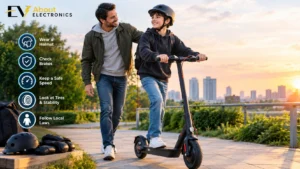
What Age Is Appropriate for an Electric Scooter?
There is no single worldwide age rule. Laws differ by country, state, city, and type of scooter. A product’s recommended age is also not a substitute for local law. For families in the United States, the AAP’s current guidance is particularly important: children under 16 should not operate or ride motorized or electric scooters.
If an older teenager is legally permitted to ride, parents should consider maturity, balance, road awareness, ability to follow instructions, and understanding of braking before allowing independent riding. Age alone does not prove that a child is ready.
Check Local Riding Laws
Before purchasing, check the rules where the scooter will actually be used. Some areas restrict minimum age, speed, road access, sidewalks, helmets, or other equipment. Do not assume that a scooter sold online is legal for every rider or every road.
How to Choose an Electric Scooter for Kids
If a teenager is old enough and legally permitted to ride, focus on control rather than maximum performance. A suitable scooter should have predictable acceleration, effective brakes, stable steering, appropriate weight, and controls the rider can operate easily. Avoid choosing a powerful model simply because it has a larger motor or higher top speed. More performance can increase the consequences of a mistake.
Choose a Manageable Weight
The rider should be able to control and move the scooter safely when it is not powered. A very heavy scooter can be difficult for a young rider to lift, turn, or handle if it needs to be moved suddenly. Weight also matters for parents who need to carry the scooter or store it indoors.
Look for Simple Controls
Simple controls can reduce distractions. The rider should clearly understand the throttle, brake levers, display, lights, and power controls before riding.
Electric Scooter Speed for Kids
Speed deserves special attention. A higher top speed may look attractive, but it reduces the time available to react and can make a fall more serious. For a young rider, the safest choice is generally a model or riding setting that keeps speed appropriate for the rider’s experience and the legal limit.
Start Slowly
A new rider should practice at a very low speed in a controlled area away from traffic. The rider needs to learn smooth acceleration, braking, turning, and stopping before using the scooter around other people. The AAP recommends starting slowly and learning how the accelerator and braking controls respond.
Electric Scooter Safety Gear
A helmet should be treated as essential equipment, not an optional accessory. The AAP recommends helmet use for children riding scooters and advises using properly fitting protective equipment. Depending on the riding environment, parents can also consider knee pads, elbow pads, gloves, and clothing that improves visibility.
Choose the Right Helmet
The helmet should fit correctly and be designed for the activity. A helmet that is too loose can move during a crash. Healthy children advises parents to make helmet use a consistent habit and to check that a helmet meets the applicable safety standard and fits correctly.
Brakes Are a Top Priority
Braking performance matters more than a flashy display or large motor. Before riding, test the brakes at low speed in a safe area. The controls should feel predictable, and the scooter should slow without pulling unexpectedly to one side. CPSC safety guidance for micromobility products recommends checking important parts before riding, including brakes, tires, handlebars, throttle, lights, cables, and the frame. Parents should teach the rider to leave enough space for stopping and never assume that a scooter can stop instantly.
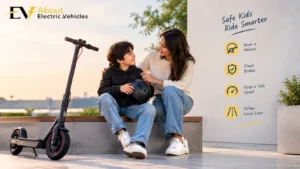
Tires and Stability
Small wheels can react strongly to potholes, cracks, rocks, and other obstacles. This makes road awareness especially important. Check tire size and condition before buying. Pneumatic tires can provide cushioning but need pressure checks and can puncture. Solid tires resist punctures but may transmit more vibration.
Electric Scooter Battery Safety
Battery safety deserves special attention because electric scooters commonly use lithium-ion battery systems. Buy from a reputable manufacturer and use the supplied charger or an approved replacement. Do not use a damaged battery, damaged charging cable, or modified charging system. CPSC warns consumers about fire risks associated with some micromobility products and recommends following manufacturer charging instructions. It also advises against charging while sleeping or leaving a charging device unattended.
Safe Charging
Charge the scooter in the location and conditions specified by the manufacturer. Keep the charging area away from materials that can easily catch fire. Never let a child experiment with batteries, chargers, wiring, or modifications.
Where Should Kids Ride an Electric Scooter?
Even whena teenager is legally allowed to ride, location matters. Avoid busy roads, highways, areas with heavy traffic, and places where pedestrians are difficult to see. The AAP advises children not to ride e-scooters in or near moving traffic. A controlled private area may be better for learning, provided local rules and property conditions allow it.
Electric Scooter for Kids: Range and Battery Size
Range should not be the main reason for choosing a youth-oriented scooter. A teenager who only needs short local trips may not need a large battery. A bigger battery can add weight and cost. Instead, choose enough range for the intended legal trips with a reasonable reserve. Actual range can be lower than the advertised figure because of rider weight, speed, hills, temperature, wind, tire pressure, and riding style.
Electric Scooter Maintenance
Regular inspection can identify problems before a ride. Check tire condition and pressure, brake operation, steering, folding mechanisms, lights, cables, and visible frame damage. Make sure important fasteners are secure. Watch for unusual noises or changes in acceleration and braking. Do not allow a child to keep riding a scooter that appears damaged.
Should Parents Buy an Electric Scooter for Kids?
For children under 16, the AAP recommends against motorized or electric scooter use. That makes a non-motorized scooter a more appropriate alternative for younger children. For an older teenager who meets the local age requirement, is mature enough to follow safety rules, and has a suitable place to ride, a properly selected scooter may be considered.
My Practical Approach for Parents
Parents should also inspect the scooter before every ride and after any impact. I would start with the child’s age and local law. If either one rules out an electric scooter, I would not buy one. If the rider is legally old enough, I would choose the lowest practical speed, predictable brakes, manageable weight, simple controls, and strong manufacturer support.
I would then buy a properly fitted helmet and any other suitable protective equipment before the first ride. I would teach braking and turning in a controlled area and make clear that riding near traffic is not acceptable. I would also keep charging and battery care under adult supervision.
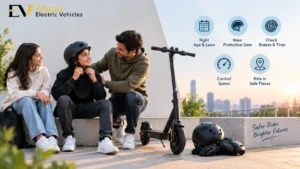
FAQs About Electric Scooter for Kids
Q.1 What is the best electric scooter for kids?
There is no single best model for every child. For legally eligible teenagers, prioritize manageable weight, controlled speed, dependable brakes, stable handling, appropriate range, and strong safety support.
Q.2 Can a 10-year-old ride an electric scooter?
The AAP recommends that children under 16 should not operate or ride motorized or electric scooters. Always check the rules in your location before allowing a child to ride.
Q.3 What safety gear does a child need?
A properly fitted helmet is essential. Depending on the activity and riding environment, knee pads, elbow pads, gloves, closed-toe shoes, and visible clothing can provide additional protection.
Q.4 How fast should an electric scooter for kids go?
Do not choose based on maximum speed. For a legally eligible young rider, use the lowest practical speed and follow local limits. The rider should be able to stop and control the scooter comfortably.
Q.5 Are electric scooters safe for teenagers?
They still carry a risk of falls and collisions. Safety depends on age, maturity, equipment, riding environment, speed, training, and compliance with local rules.
Conclusion
An electric scooter for kids should never be treated like an ordinary toy. The most important factors are age, local legality, maturity, speed control, braking, protective equipment, battery safety, and riding environment.
The American Academy of Pediatrics recommends that children under 16 should not ride motorized or electric scooters. For older teenagers who are legally permitted to ride, parents should choose a manageable and well-supported model and teach safe riding before independent use. When safety comes first, the goal is not to find the fastest scooter. It is to find an option that the rider can control responsibly and use only where it is appropriate and legal.