
For millions of older adults, the hardest part of aging is not the birthday — it is the slow shrinking of the world. The grocery store gets farther, the park feels out of reach, and visiting friends starts to depend on someone else’s schedule. Electric scooters for seniors exist to push that world back open again. These are not the standing kick scooters you see zipping through city traffic. They are seated, stable, four-wheeled mobility scooters built for comfort, safety, and everyday independence — and choosing among electric scooters for seniors comes down to a handful of practical decisions this guide walks you through.
What Electric Scooters for Seniors Actually Are
A mobility scooter is a battery-powered, seat-based vehicle steered by a handlebar tiller. You sit in a padded, often swiveling chair, control speed with a thumb lever or twist grip, and travel at walking-to-jogging pace — typically 4 to 8 mph. Most models are designed for pavements, shopping centers, parks, and smooth neighborhood paths rather than roads.
The key difference from a regular electric scooter is stability. Four wheels, a low center of gravity, and a wide seat mean you do not balance — you sit. That makes electric scooters for seniors suitable for people with limited stamina, knee or hip problems, or balance concerns, where a bicycle or a standing scooter would be unsafe.
The Four Types of Electric Scooters for Seniors, and Who Each Suits
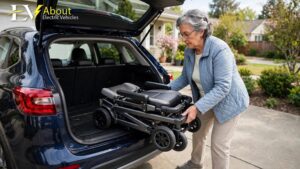
Travel / portable scooters. These break apart into four or five lightweight pieces (the heaviest usually 30–35 lbs) that fit in a car trunk. Range is modest, around 8–15 miles, and weight capacity is typically 250–300 lbs. Best for: shopping trips, doctor visits, cruises, and anyone who travels by car.
Folding scooters. These collapse in one piece, like a rolling suitcase, with no disassembly. The Pride Go-Go Folding Scooter, for example, folds to 30″ x 19″ x 18″, weighs 52 lbs complete, and covers up to 9.3 miles per charge. Best for: people who want the simplest possible loading, especially for air travel and cruises.
Mid-size scooters. Bigger batteries, comfier captain-style seats, and 15–25 miles of range. They are still transportable in larger vehicles but are mainly meant for daily neighborhood use. Best for: the everyday all-rounder.
Heavy-duty scooters. Built for higher weight capacities (400–500 lbs), rougher ground, and longer range — some reach 25–35 miles. They are larger, heavier, and usually need a vehicle lift. Best for: larger riders, rural paths, and all-day outdoor use.
Top Models and Prices in 2026
Prices below are verified street prices from current 2026 listings for electric scooters for seniors; always confirm with a dealer, as promotions change.
Model | Best For | Weight Capacity | Range | Top Speed | Price (approx.) |
|---|---|---|---|---|---|
Pride Go-Go Elite Traveller | Ease of transport | 300 lbs | ~14 miles | ~4 mph | ~$1,260 |
Pride Go-Go Sport 4-Wheel | Best all-round travel scooter | 325 lbs | ~12 miles | 4.7 mph | ~$1,719 (MSRP $2,299) |
Golden Buzzaround XL | Comfort + portability | 300 lbs | ~14 miles | ~4 mph | ~$1,400–$2,000 |
Drive Phoenix HD 4 | Higher capacity, stability | 350 lbs | ~15 miles | ~4 mph | ~$1,600–$2,300 |
Pride Go-Go Folding Scooter | One-step folding | 250 lbs | ~9.3 miles | ~4 mph | ~$2,399 |
Across the whole market, electric scooters for seniors span roughly $650 to $5,000. Entry-level travel models cluster around $900–$1,600, mid-range models $1,500–$2,800, and heavy-duty or extended-range designs pass $3,000. Certified refurbished models typically run 30–50% less and are a sensible budget route if they come with a warranty.

How to Choose: The Five-Point Checklist
1. Weight capacity — with margin.
Choose a scooter rated at least 20–30 lbs above the rider’s weight, including bags and shopping. Running a motor near its limit shortens battery life and strains the drivetrain.
2. Real range, not brochure range.
Treat claimed range like a best case: a heavier rider, hills, cold weather, and rough paths all cut it. If your daily round trip is 8 miles, buy a scooter rated for at least 12–14 miles.
3. Portability vs. comfort.
Every pound of comfort costs portability. If a carer loads the scooter alone, the heaviest single piece matters more than total weight. Test the disassembly yourself before buying.
4. Turning radius and width.
A tight 32–37 inch turning radius is what makes a scooter usable inside shops and at home. Measure your narrowest doorway and hallway first — most travel scooters are about 19–22 inches wide.
5. Seat and tiller fit.
On electric scooters for seniors, a swivel seat with adjustable armrests makes getting on and off far easier on stiff knees. The tiller should adjust to your reach so you are not hunching forward for an hour.
Batteries, Charging, and Running Costs
Most senior mobility scooters use sealed lead-acid batteries, with lithium-ion appearing on folding and premium models. Lead-acid packs are cheaper but heavier and need replacing every 12–18 months with daily use; lithium packs last longer and charge faster but cost more upfront.
Charging is simple: plug the scooter (or its removable battery box) into a standard wall outlet overnight, typically 6–8 hours for a full charge. Electricity costs are tiny — a few cents per charge. The real running cost is batteries, roughly $100–$300 for a lead-acid pair when replacement time comes, plus tires every couple of years. That is still a fraction of running a car, which is why many owners find their electric scooters for seniors pay for themselves within a year of giving up short car trips.
Battery care follows the same rules as any electric vehicle: avoid fully draining the pack, store the scooter charged in a dry place, and top up the charge monthly if it sits unused. Cold garages in winter will temporarily cut range, so keep the scooter indoors when you can.
Will Medicare or Insurance Pay?
This is the question every buyer asks, and the honest answer is: sometimes, with paperwork. In the United States, Medicare Part B may cover part of the cost of a mobility scooter when a doctor documents that it is medically necessary for daily life inside the home, and the purchase goes through an approved supplier. Coverage is not automatic, it rarely covers the full price, and the process takes weeks. Medicaid programs and some private insurers have similar, state-dependent rules.
Practical advice: get the doctor’s assessment first, then talk to an approved local dealer who handles the paperwork daily — they know which forms get approved. If insurance declines, ask about refurbished models, seasonal sales, and veterans’ or charity programs, which quietly help many buyers.
Safety Tips That Actually Matter
Start in an empty car park, not on a busy pavement. Practice turning, reversing, and stopping until the controls feel boring. Keep speed low around pedestrians and dogs, and remember that at 4 mph you are faster than you feel — give people time to hear and see you. A high-visibility flag, a horn, and lights are cheap additions on electric scooters for seniors that prevent most close calls.
Watch kerbs and ramps: approach them straight on, never at an angle, and avoid wet grass and gravel slopes that can trap small wheels. Finally, keep the battery gauge in mind the way a driver watches fuel — the last quarter of charge is not the time to start a long trip home.
Maintenance: Almost Nothing, But Not Nothing
Like all electric scooters for seniors, a mobility scooter needs far less care than a car: wipe it down, check tire pressure monthly, keep the battery charged, and have the brakes and bearings checked once a year. Most dealers offer an annual service for a modest fee, and it is worth it — catching a worn tire or loose connection early avoids being stranded later. Store the scooter dry, and if you will not use it for a month, leave the battery topped up rather than flat.

FAQs About Electric Scooters for Seniors
Q.1 Are electric scooters for seniors safe for people with balance problems?
Yes — that is exactly what they are designed for. Four wheels, a low seat, and a stable base mean you sit rather than balance. Choose a 4-wheel model over a 3-wheel one if stability is your main concern, and practice in a quiet area first.
Q.2 How far can a mobility scooter go on one charge?
Travel models typically cover 8–15 miles, mid-size models 15–25 miles, and heavy-duty models up to 35 miles. Real-world range is usually 20–30% below the brochure figure once rider weight, hills, and cold weather are factored in.
Q.3 Do I need a license or registration?
In most countries, no license is needed for pavement-class mobility scooters, and road-class models (up to 8 mph) require registration but not a driving license in the UK. Rules vary by state and country, so check your local rules before buying a faster model.
Q.4 Can a mobility scooter go in a car or on a plane?
Travel scooters disassemble into trunk-sized pieces, and folding scooters collapse in one piece. Many airlines accept mobility scooters, especially with sealed or airline-approved lithium batteries — always confirm battery rules with the airline before flying.
Q.5 How much do electric scooters for seniors cost to run?
Very little. Charging costs pennies per charge. Expect a lead-acid battery replacement every 12–18 months ($100–$300), tires every couple of years, and an optional annual service. Compared with a car, running costs are almost negligible.
Q.6 What is the difference between a mobility scooter and a regular electric scooter?
A mobility scooter has a seat, four wheels, and a tiller, and travels at 4–8 mph — it is a medical mobility aid. A regular electric scooter is a standing kick scooter that travels at 15–68 mph and needs balance. They serve completely different riders.
Conclusion
The best electric scooters for seniors are not the fastest or the flashiest — they are the ones that fit the rider’s weight, home, car, and daily routes, and that get used every single day without a second thought. Start with the five-point checklist, be honest about range, try before you buy where possible, and check the insurance paperwork early. Done right, electric scooters for seniors do not just move you from A to B — they hand back the independence to decide when, where, and with whom you go. That is worth far more than any spec sheet.