
An off road electric scooter is built for terrain that can be difficult for ordinary commuter scooters. Gravel, packed dirt, grass, uneven trails, loose surfaces, and rough private roads place very different demands on the motor, tires, suspension, frame, and brakes.
A powerful motor alone does not make a scooter suitable for off-road riding. Good ground clearance, suitable tires, controlled power delivery, effective suspension, strong braking, and a durable frame all matter. The rider also needs to understand where the scooter can legally be used and how terrain changes stopping and handling. This guide explains the features that matter most, how to choose the right setup, and how to ride and maintain an off-road model safely.
What Is an Off Road Electric Scooter?
An off road electric scooter is an electric scooter designed to handle surfaces beyond normal smooth pavement. Depending on the model, that can include gravel, dirt paths, grass, packed trails, and other uneven terrain. Not every scooter marketed as “all-terrain” is equally capable. Some are mainly road scooters with treaded tires, while more serious models use larger pneumatic tires, substantial suspension, higher clearance, stronger frames, and one or two motors.
Where Can You Ride One?
Off road electric scooter capability does not automatically give you permission to ride anywhere. Access depends on local laws, land ownership, trail rules, and the classification of the vehicle. Before riding, check the rules for the specific road, trail, park, or property. CPSC also advises micro mobility users to follow local traffic laws and manufacturer directions.
Motor Power and Torque
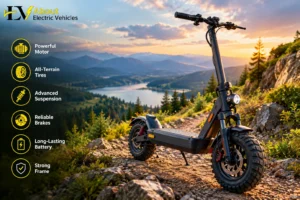
Motor power becomes more important when the surface is loose or the route includes hills. A strong motor can help maintain momentum when climbing, but advertised wattage should not be viewed as the only measure of capability.
Dual-motor scooters can send power to both wheels and may provide better traction and hill performance than comparable single-motor designs. They can also consume more battery and add weight.
For off-road use, smooth throttle response matters as much as peak output. A sudden burst of power can make a loose surface harder to control. A well-tuned controller can deliver power more progressively.
Battery Capacity and Range
Off-road riding can use more energy than smooth pavement because the scooter may work harder over rough ground, hills, soft surfaces, and repeated changes in speed. Do not plan a remote trail ride around the maximum range printed in an advertisement. Leave a practical reserve for the return trip.
Tires Are Critical Off Road
Tires are among the most important components for rough terrain. Road-oriented tires may work well on pavement but can provide less predictable grip on loose surfaces.
Pneumatic tires are common on more capable off-road scooters because the air cushion can improve comfort and help the tire conform to uneven ground. Knobby or more aggressive tread can provide better traction on suitable dirt and loose surfaces. Tire size also matters. Larger tires can roll over small obstacles more easily than very small wheels.
Tire Pressure Matters
If the scooter uses pneumatic tires, maintain the pressure recommended by the manufacturer. Pressure changes how the tire behaves and affects handling, rolling resistance, and impact absorption. Running too low can increase the risk of tire damage and make steering less predictable. Running too high can reduce cushioning and make rough terrain feel harsher.
Do not copy the pressure used by another scooter simply because the tire looks similar. Use the specifications for your exact model and tire. Inspect the tread and sidewalls before riding. Look for cuts, embedded objects, bulges, and other damage.
Suspension and Ground Clearance
Suspension is one of the clearest differences between a basic commuter scooter and a serious off-road design. Front and rear suspension can help control repeated impacts and keep the wheels in better contact with uneven ground.
However, suspension cannot compensate for inadequate ground clearance. If the deck or another low component repeatedly hits rocks or obstacles, the scooter can be damaged and the rider can lose control. Look at the complete setup: clearance, travel, damping, spring rate, wheel size, and frame strength.
Brakes for Rough Terrain
Strong brakes are essential because off-road routes can change quickly. Descents, loose dirt, wet surfaces, and obstacles can make stopping more difficult. Hydraulic disc brakes are common on higher-performance scooters, but brake type alone does not guarantee good stopping. Rotor size, pad condition, tire grip, rider weight, and brake setup all matter.
Test the brakes before entering difficult terrain. CPSC recommends checking scooter components and knowing how the brakes behave before riding. Keep braking smooth on loose ground. Sudden braking can reduce traction and cause a wheel to slide.
Frame Strength and Build Quality
Rough terrain creates repeated impacts. A durable frame, strong steering components, secure fasteners, and suitable wheel assemblies are therefore important. Pay attention to the folding mechanism if the scooter has one. A complex folding system can have more parts that need inspection than a rigid frame.
Check for unusual movement, cracks, loose bolts, damaged cables, and signs of impact. Stop riding if an important structural component appears damaged.
Water and Weather Resistance
Off-road riding can expose a scooter to mud, wet grass, puddles, and rain. Check the manufacturer’s water-resistance rating and limitations before riding in wet conditions. Avoid deep puddles when you cannot determine their depth. After wet riding, inspect and clean the scooter according to the manufacturer’s instructions.
How to Ride Off Road Safely
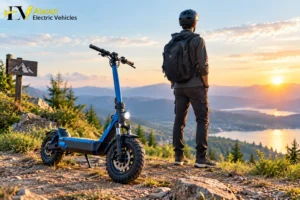
Rough terrain requires a different riding style. Reduce speed before obstacles instead of approaching them quickly. Keep both hands on the handlebars and maintain a balanced stance. CPSC specifically advises riders to keep both hands on the handlebars, slow down for bumps, and stay aware of obstacles.
Avoid sharp steering inputs on loose gravel. Brake before a difficult section when possible rather than during the middle of it. Stand slightly flexed when the scooter design allows it. Your arms and legs can help absorb smaller movements while keeping your center of balance controlled. Never assume a trail is safe simply because another vehicle used it.
Protective Gear
A helmet should be the starting point for protective equipment. CPSC recommends wearing a bicycle helmet when riding e-scooters. For faster or more demanding off-road riding, additional protection can be useful. Depending on the terrain and speed, riders may consider gloves, eye protection, knee protection, elbow protection, and suitable clothing.
Maintenance After Rough Riding
Off road electric scooter use can accelerate wear. After a demanding ride, remove dirt and inspect the scooter before storing it. Check tires for cuts and embedded stones. Examine the suspension, brakes, steering parts, frame, fasteners, and cables. Mud should not be allowed to build up around moving parts or cooling areas. Clean the scooter using the method approved by the manufacturer rather than directing high-pressure water at sensitive components.
Pay special attention to loose bolts and unusual noises. A small problem found early can be easier and cheaper to repair. Before each ride, inspect the controls, tires, brakes, steering, and frame, especially after impacts, falls, long trail sessions, or repeated use.
How to Choose the Right Model
Start with your terrain. If you mainly ride pavement with occasional gravel, a light mixed-terrain scooter may be enough. If you regularly ride dirt, steep paths, or rough trails, prioritize suspension, clearance, tires, braking, and drivetrain capability.
Next, consider your body weight and cargo. Make sure the manufacturer’s load limit comfortably covers the total load. Then evaluate portability. Powerful off-road scooters can be heavy and awkward to lift into a car. Finally, check replacement-part availability and service support. Tires, tubes, brake pads, suspension parts, chargers, and other components will eventually need attention.
Common Buying Mistakes
One mistake is choosing a scooter because it has aggressive-looking tires. Tires cannot compensate for weak suspension, poor brakes, low clearance, or inadequate frame strength. Another mistake is buying based only on peak motor wattage. Real off-road performance depends on the complete powertrain and the rider’s terrain. Ignoring weight is another problem. A scooter can be excellent on a trail but impractical if you cannot transport it.
FAQs About Off Road Electric Scooter
Q.1 What makes an electric scooter good for off road riding?
Useful characteristics include suitable pneumatic tires, adequate ground clearance, effective suspension, strong brakes, durable construction, and enough motor and battery capability for the terrain.
Q.2 Are dual-motor scooters better for off road riding?
They can provide better traction and climbing ability, particularly on loose or steep terrain. However, they usually add weight, cost, and energy consumption. The benefit depends on where you ride.
Q.3 Can I use an off road electric scooter on normal roads?
Some models can be used on roads, but legality depends on your location and the scooter’s classification. Check local rules before riding.
Q.4 Are off road electric scooter waterproof?
Not necessarily. Water resistance varies by model. Check the manufacturer’s rating and instructions, and do not assume an IP rating means the scooter can be submerged.
Q.5 How much suspension does an off road electric scooter need?
There is no single ideal amount. What matters is the complete suspension system, including travel, damping, spring setup, wheel size, and the terrain you intend to ride.
Q.6 Are off road electric scooter safe?
They can be ridden more safely with proper equipment, controlled speed, suitable terrain, and regular maintenance. Rough surfaces increase the chance of losing control, so riders should use appropriate protective gear and inspect the scooter regularly.
Conclusion
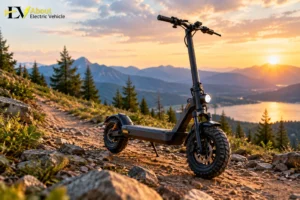
An off road electric scooter should be chosen as a complete machine, not simply by its motor wattage or appearance. Tires, suspension, ground clearance, brakes, battery capacity, frame strength, and power delivery all contribute to its real capability. For mild gravel and maintained dirt paths, a capable mixed-terrain model may be sufficient. More demanding trails require stronger hardware and greater attention to riding technique and maintenance.
Before buying, define the terrain you actually plan to ride, check local access rules, and choose specifications that match those conditions. With the right scooter, sensible speed, protective equipment, and regular inspections, off road riding can be enjoyable without treating the machine or the trail as indestructible.