
An e-bike might be the smartest purchase of your college years: no parking permits, no gas, no bus schedules — just a five-minute zip to any lecture hall. But student life has its own rules, and the best electric bikes for college students are not simply the cheapest ones. They fold into dorm corners, charge from a wall socket, survive being locked outside in the rain, and don’t cost more than a semester of textbooks. Here are the five best electric bikes for college students in 2026, picked and priced for real student budgets.
What Students Actually Need (It’s Not Top Speed)
Storage beats specs.
If your bike lives in a dorm room or a shared apartment hallway, a folding frame is worth more than 200 extra watts. If it lives on an outdoor rack, weight matters less and durability matters more.
A removable battery.
Many dorms and campus buildings restrict where e-bikes can be charged — some ban indoor charging entirely after widely reported battery fires. A removable pack you can charge at your desk (where allowed) beats wheeling a 60 lb bike into an elevator. Always check your university’s e-bike policy before buying: some campuses also limit which e-bike classes can use bike paths.
Theft resistance is a feature.
Bikes are among the most-stolen items on any campus. Budget $60–$100 for a serious U-lock, register your bike’s serial number, and prefer bikes that don’t scream their price. A $999 bike you still own in May beats a $2,500 bike stolen in October.
The honest total budget.
Bike + lock + helmet + a basic service once a year. Our five picks below all land under $1,400 for the bike itself, and most are under $1,000.
Buy from a brand that will still exist at graduation.
This sounds obvious, but the graveyard of student e-bikes is filled with no-name imports whose chargers, batteries, and controllers became unobtainable within two years. Every brand in this guide has a real US presence, spare parts, and a warranty you can actually claim — which is precisely why they earned their place among the best electric bikes for college students rather than cheaper one-season wonders.
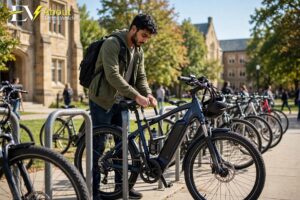
The 5 Best Electric Bikes for College Students
Following are the 5 Best Electric Bikes for College Students:
1. Lectric XP Lite 2.0 — Best Overall for Students
The XP Lite 2.0 is the student default for good reason: $799, folds flat in seconds, weighs 49 lbs, and runs a 48V system with hydraulic disc brakes — rare at this price. Range is up to 45 miles on the standard battery (a long-range version reaches 80), far beyond any campus need. It fits in a dorm corner, a car trunk for the ride home at break, and a student budget. If you only test-ride one bike, make it this one.
2. Ride1Up Portola 02 — Most Power for the Money
Living off campus with a longer, hillier commute? The Portola 02 folds like the Lectric but packs a 750W motor with 90 Nm of torque, switchable torque/cadence sensing, and battery choices up to 720 Wh good for roughly 40–50 real-world miles. The standard model ($1,095) adds a welded 150 lb rear rack, fenders, and turn signals; the Lite starts at $895. The trade-off is weight — around 61–63 lbs — so it’s a folder you roll into storage, not one you carry up three flights daily.
3. Aventon Soltera 2.5 — Best “Real Bike” Feel
Not everyone wants a folding bike. The Soltera 2.5 ($999) looks and rides like a normal city bike, with a smooth torque sensor that makes pedalling feel natural, and at about 46 lbs it’s one of the lightest full-size options here. Aventon’s network of 1,800+ US dealers is a genuine student advantage: when something breaks during term, a local shop can fix it this week instead of you learning e-bike repair on YouTube between exams.
4. Ride1Up Roadster V3 — Best Lightweight Performer
At roughly 40 lbs, the Roadster V3 is the easiest bike on this list to carry up dorm stairs, and the cleanest-looking — most people won’t guess it’s electric, which does no harm on a theft-prone campus. Its 500W motor assists to 28 mph (Class 3) and the price is about $1,395. Range is modest at 20–40 miles, but campus trips are short; this bike trades marathon range for lightness and style, a trade most students should happily make.
5. Retrospec Beaumont Rev 3 — Best Comfort on a Budget
The Beaumont Rev 3 ($999) is the relaxed option: an upright step-through frame, swept bars, fenders, a rear rack, and a chainguard included — it arrives ready for grocery runs and rainy rides to class with zero accessories to buy. Range is up to 42 miles. At 57.5 lbs it’s no stair-climber, so it suits students with ground-floor or rack storage who value comfort and completeness over portability.

Comparison Table
Bike | Price | Weight | Range (claimed) | Standout Feature | Best For |
|---|---|---|---|---|---|
Lectric XP Lite 2.0 | $799 | 49 lbs | Up to 45 mi (80 LR) | Folds, hydraulic brakes | Best overall |
Ride1Up Portola 02 | From $895 | 61–63 lbs | ~40–50 mi | 750W, 90 Nm, big battery | Longer commutes |
Aventon Soltera 2.5 | $999 | ~46 lbs | Up to ~46 mi | Torque sensor, dealer network | Real-bike feel |
Ride1Up Roadster V3 | ~$1,395 | ~40 lbs | 20–40 mi | Lightest, Class 3 | Stairs & style |
Retrospec Beaumont Rev 3 | $999 | 57.5 lbs | Up to 42 mi | Rack & fenders included | Comfort budget |
What an E-Bike Really Costs vs a Car or Bus Pass
Run the student maths and the case makes itself. A campus parking permit alone commonly runs $200–$600 a year — before fuel, insurance, and repairs on a student-grade car that will reliably add four figures more. A transit pass is cheaper, but still typically $300–$800 a year, and it runs on the bus company’s schedule, not yours.
Against that, even the priciest of the best electric bikes for college students pays for itself fast: a $999 bike plus a $100 lock, charged for pennies a week (a full charge uses roughly half a unit of electricity), typically breaks even against a single year of parking-plus-fuel costs — and then keeps saving for the remaining three years of your degree. Maintenance is student-friendly too: brake pads, a chain, and tyres, with no oil, filters, or inspections. Spread across four years, the best electric bikes for college students work out at well under a dollar a day — less than the coffee you will buy because the e-bike got you to the café before the queue formed.
Student Survival Tips (Read Before You Buy)
Check your campus rules first. A five-minute read of your university’s transportation page can save a $1,000 mistake: dorm charging bans, class restrictions, and registration requirements are all common now.
Lock it like you mean it. U-lock through the frame to a fixed rack, never just the front wheel, and take the battery with you when it’s removable — it is the most valuable and most portable part. Our guide to electric bike battery replacement cost shows exactly why: that pack is a $300–$800 component on its own.
Care for the battery and it pays you back. Charge at room temperature, avoid storing the pack fully empty or full for weeks over break, and your battery will outlast your degree — the full habits are in our electric bike battery life guide.
FAQs About the Best Electric Bikes for College Students
Q.1 What is the best electric bike for a college student?
The Lectric XP Lite 2.0 is our top pick for most students: it folds for dorm storage, weighs 49 lbs, has hydraulic brakes, and costs $799. Students with long off-campus commutes should look at the Ride1Up Portola 02; those wanting a normal-bike feel, the Aventon Soltera 2.5.
Q.2 How much should a student spend on an e-bike?
Between $800 and $1,400 covers every good option, plus about $100–$150 for a quality U-lock and helmet. Cheaper no-name bikes often lack UL-certified batteries and any service network — a false economy if it breaks mid-semester.
Q.3 Are e-bikes allowed in dorms?
Rules vary widely. Many universities ban charging or storing e-bikes in dorm rooms due to battery fire concerns, while allowing them in designated bike rooms. Check your housing and campus transportation policies before buying — a removable battery and outdoor-rated storage plan help in most cases.
Q.4 Is a folding e-bike worth it for college?
If your storage is a dorm room, apartment, or car trunk, absolutely — folding models like the XP Lite 2.0 and Portola 02 disappear into a corner. If you have secure ground-floor storage, a lighter full-size bike like the Roadster V3 rides better.
Q.5 How do I stop my e-bike being stolen on campus?
Use a hardened U-lock through the frame to a fixed rack, park in busy lit areas, remove the battery and any display, register the serial number with your campus police or a national registry, and photograph the bike. Consider a small GPS tracker if the bike is expensive.
Q.6 How far does a student e-bike need to go?
Campus trips are usually 1–5 miles, so even 25 miles of real range is plenty for a week of classes between charges. Only off-campus commuters riding 10+ miles daily need the big-battery models.

Conclusion
The best electric bikes for college students are the ones that fit student life, not just a spec sheet: foldable or light enough for your storage, priced within a real budget, serviceable in your college town, and locked like they matter. Start with the XP Lite 2.0 if you’re unsure — it is the safest all-round answer — then match the alternatives to your commute distance and staircase count. Buy right, and your e-bike will pay for itself in saved parking permits and bus fares before your first finals week. And when graduation finally comes, a well-kept brand-name e-bike holds real resale value on the same campus marketplace where you bought your textbooks — the last student discount of all.